 Guide
GuideIs the LEGO Millennium Falcon Worth It? (Honest Take)
If you've been asking yourself whether the LEGO Millennium Falcon is worth it, you're probably staring at a set that's a lot bigger, and a lot pricier, than most things in your cart. There's more than one Falcon on shelves right now, from smaller microfighter takes to the full-size standard scale build (set 75257, 1,328 pieces), and they land in very different budgets. That's a real question to sit with before you click buy, especially with a licensed Star Wars set where you're paying for the ship as much as the piece count.
We're not going to tell you it's a must-have for every fan, because it isn't. It's a genuinely satisfying build for the right person and a shelf hog for the wrong one, and the honest answer depends more on where you're going to put it and how much you care about the interior detail than on anything to do with the Star Wars license itself.
Below is what actually matters when you're deciding, based on what the set does well, where it drags, and who ends up disappointed after the box is unwrapped.
What you're actually paying for
A Millennium Falcon set isn't priced like a generic City set of the same piece count, and that's worth saying up front. Star Wars sets carry a license premium, and the Falcon carries an extra one on top of that because it's the single most requested ship in the whole theme, the one new fans and lapsed fans both ask about first. You're paying for the ship's shape being unmistakably right (the cockpit tube, the mandibles, the radar dish), for the interior rooms LEGO designers keep cramming in, and for the fact that it's arguably the most recognizable model in the entire LEGO Star Wars catalog. That recognizability matters more than it sounds like it should. A lot of Star Wars sets are ships or vehicles that only die-hard fans recognize on sight. The Falcon is the rare exception where a relative, a coworker, or a kid who's never watched a single film still knows exactly what's sitting on your shelf. If none of that moves you, a smaller ship or a different Star Wars set will get you more play value per dollar spent. If it does move you, this is one of the rare licensed sets where the premium buys something real, and not just a sticker of a logo on an otherwise ordinary build.
The build itself
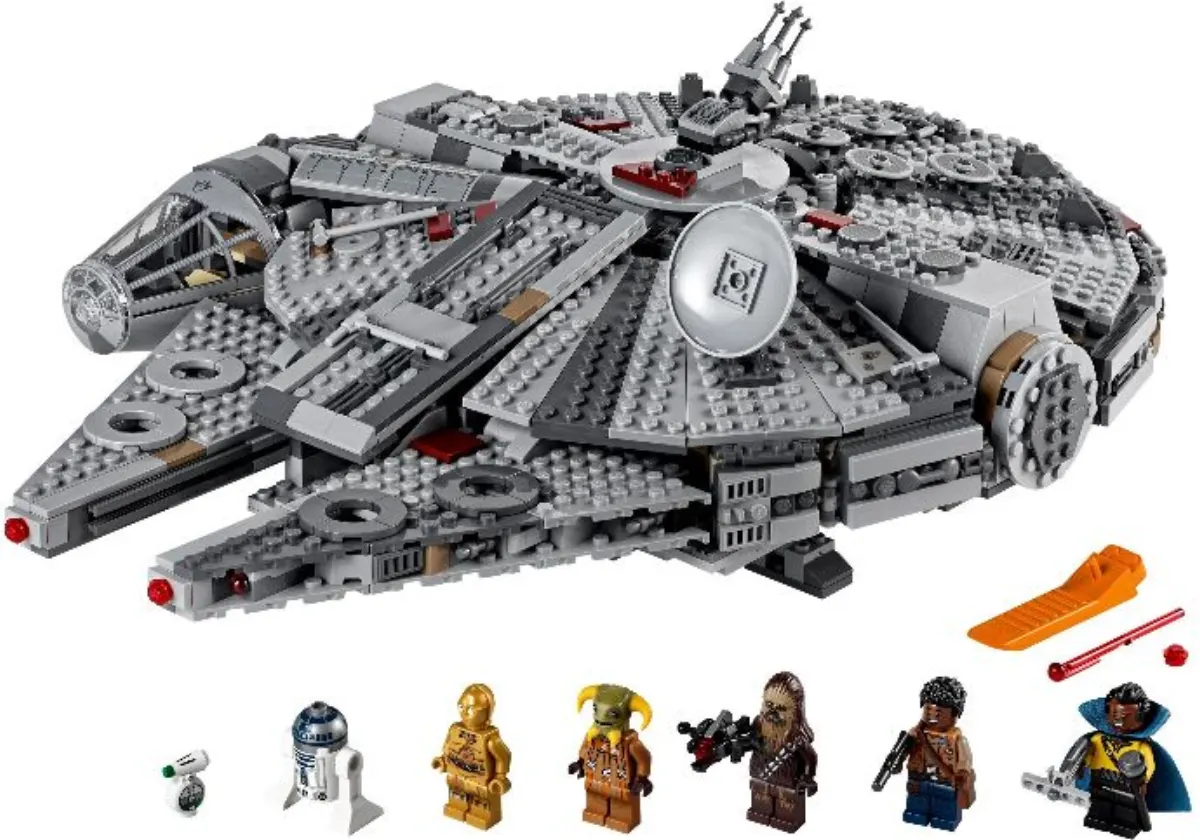
The Falcon builds in distinct phases: the underlying frame first, then the hull panels, then the interior rooms get slotted in almost like furniture before the top comes down and seals it all in. That structure means the build has real peaks and valleys, and it helps to know that going in rather than being surprised by it halfway through a bag. The frame stage is the most technical part and genuinely interesting if you like understanding how a model holds its own shape and weight without sagging, since a lot of engineering goes into keeping a wide, flat model like this from bowing in the middle once it's fully loaded with interior detail. The panel stage, where you're attaching dozens of similar-looking curved pieces to build out the hull, is the part that tends to drag. It's not hard, exactly, it's just repetitive in a way that can make an evening feel longer than it is, especially if you're building solo without anyone to hand you bags or talk through it with. The interior furnishing near the end (the cockpit seats, the hidden smuggling compartment, the game table, the little escape pod bay depending on the version) is where the build gets fun again, because you can finally see the ship becoming a set instead of a shell. Pace yourself around that middle stretch and the build reads as far more enjoyable start to finish than if you try to power through it in one long sitting.
How it actually displays
This is where the Falcon earns its reputation, and honestly where it separates itself from a lot of other big licensed sets. Once it's built, the ship sits flat and solid, the panel lines actually read as panel lines instead of a smooth blob, and it looks correct from more angles than most LEGO ships manage, whether you're looking down at it from above or straight on at eye level with the cockpit. The hinged top opening to reveal the interior is a real party trick, not a gimmick that stops working after the first time you show someone. Where it struggles is footprint. This is a wide, low model, not a tall one, and it eats up shelf or table space in a way a lot of buyers underestimate before it arrives, especially once you factor in the dish and mandibles that stick out past the main hull on either side. Measure your actual display spot before you order, not just in your head, and account for a few extra inches of clearance around the whole thing. A set that photographs beautifully in a review still needs somewhere real to live, and a Falcon crammed onto a shelf that's too small ends up looking cramped rather than impressive, which undercuts the entire reason you bought it.
Where the piece count goes
A chunk of the piece count in any Falcon set goes toward the exterior hull, which is a lot of similar curved and wedge pieces doing structural, repetitive work rather than anything visually interesting on its own. That's normal for a ship this size and it's not a knock on the set, but it does mean the piece count alone overstates how varied the build feels compared to a themed set with the same number of pieces spread across distinct rooms or vehicles or minifigure scenes. A 1,000-piece castle set and a 1,000-piece Falcon are not the same kind of building experience, even though the box says the same number. If you're the kind of builder who wants variety in every bag, something new to figure out every ten minutes, know that stretches of this build are more meditative than surprising, and that's worth weighing against your own patience for repetition. If you like the repetitive, assembly-line satisfaction of building a hull section by section and watching a shape slowly emerge from what looked like an undifferentiated pile of curved plates an hour earlier, that's exactly what you're signing up for, and it delivers on that specific kind of satisfaction better than almost any other set we can think of.
The minifigures and small stuff
Falcon sets typically come with a small crew of minifigures tied to whichever film era the set is themed around, plus small in-universe accessories like weapons, cargo pieces, or a bit of scatter detail for the interior rooms. They're a nice bonus and they give the ship some scale reference when it's posed on a shelf next to other Star Wars sets, but nobody buys a Falcon for the minifigures, and you shouldn't either. The figure count relative to the price is not where this set wins. If figures are your main draw, a smaller, cheaper Star Wars set built around a battle scene will usually get you a bigger crew for less money, sometimes considerably less. Buy the Falcon for the ship, full stop. Treat the figures as the bonus they are, a nice detail for staging photos rather than a reason to justify the price to yourself.
Who this set is wrong for
Skip it, or size down, if you're tight on display space, if you want a build that stays interesting through every single stage, or if your main interest is Star Wars minifigures rather than a ship model. It's also not the pick for a builder who wants to finish in one sitting or someone shopping mainly on a piece-count-per-dollar basis, since the license premium works against you there no matter which Falcon you pick. Depending on which Falcon you're looking at, this is realistically a multi-session build, and rushing the panel stage is where mistakes happen, loose pieces, mismatched panels, a hull that doesn't sit quite flush. If any of that describes you, look at one of the smaller-scale Falcons instead, which trade some interior detail and screen accuracy for a build that's faster and a footprint that's easier to live with, and which still deliver that unmistakable silhouette without asking for a whole shelf to themselves.
Who it's genuinely worth it for
It's worth it for a builder who wants a centerpiece, not a quick weekend project, and who has already decided the Falcon is the ship they want on their shelf rather than settling for whatever Star Wars set was on sale. It's also a strong pick if you like display models with real interior detail, since the payoff at the end (opening the hull and seeing the finished rooms) is the kind of moment that makes the slower stretches of the build worth it in hindsight. If that's the reader nodding along right now, this is one of the few licensed sets where the reputation actually matches the experience.
The Millennium Falcon is worth it if you want a genuine centerpiece and don't mind a build with a slow middle stretch, but it's not a casual pick. Measure your shelf space, decide how much interior detail actually matters to you, and pick the scale that matches both before you pay the license premium.
Common questions
Which LEGO Millennium Falcon should I buy?
It depends on your budget and space. The larger, standard scale Falcon builds have more interior detail and a bigger footprint, while smaller Falcon sets (including microfighter scale) trade detail and screen accuracy for a faster build and an easier shelf spot. Check current availability, since LEGO doesn't publish a retirement calendar and older Falcon versions can disappear from shelves without much notice.
Is the Millennium Falcon good for kids to build?
The bigger Falcon sets are better suited to experienced builders or an adult and kid building together, mostly because of the length and the repetitive hull-panel stretch in the middle. A younger or newer builder is likely to lose steam partway through. A smaller-scale Falcon set is a more realistic solo build for a kid.
Does the Millennium Falcon come apart or is it one solid build?
The hull is designed to open up (the classic party trick of this ship), revealing interior rooms underneath rather than being a single sealed shell. It's sturdy once built and holds together well for display, but it's built in sections rather than as one continuous piece.
Is the Millennium Falcon a good investment?
We'd be careful with that framing. Some retired LEGO sets do reportedly appreciate over time, but LEGO doesn't guarantee or publish a retirement schedule, and resale value is never certain. Buy the Falcon because you want to build and display it, not primarily as a financial bet.