

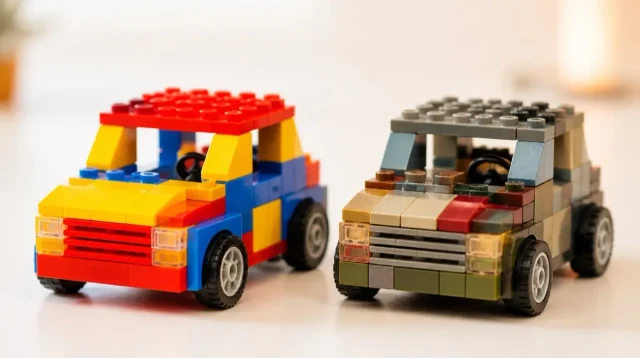
Are LEGO Knockoffs Worth It? What You Give Up
LEGO knockoffs look tempting when a set costs half as much, but the savings come from somewhere. Here's what actually changes when you swap a real set for a clone.
Search for almost any popular LEGO® set and you'll find a cheaper clone sitting right next to it, often with a near-identical box and a name that's just different enough to avoid a lawsuit. It's a fair question to ask: are LEGO knockoffs worth it, or are you just paying less for less? The honest answer is that it depends on what you're building for. A knockoff can be a reasonable choice for a one-off display piece you'll never touch again. It's a much riskier choice for anything a kid is going to build, rebuild, and drag around the house for the next five years.
We're not going to pretend every off-brand set is garbage, because some of the bigger clone manufacturers have gotten genuinely good at the plastic and the printing. But "good enough to look fine on a shelf" and "good enough to survive real use" are two different bars, and the gap between them is where most of the disappointment lives. This guide walks through what you're actually trading away when you buy the cheaper box, so you can decide with your eyes open instead of finding out the hard way.
The short answer
A LEGO knockoff can be a reasonable call for a display piece that won't get handled much, or for an original brick brand that isn't copying anyone's design. For anything that gets built, rebuilt, and played with regularly, the savings usually come out of clutch power, part durability, and instruction quality, and that's the part that shows up months later, not on the shelf.
What counts as a knockoff
Not every non-LEGO brick is the same kind of product. Some companies build entirely original sets with their own designs and don't try to look like LEGO at all. Others produce near-copies of specific LEGO sets, right down to the box art and instruction booklet style, swapping only the logo and a few piece numbers. The second category is what most people mean by "knockoff," and it's also the category that raises the most legal and quality questions, since these companies are often reverse-engineering a design LEGO spent real money developing. If a set's box looks suspiciously like a LEGO set you've seen before, with a name that rhymes or nearly matches, that's usually a clone rather than an original design.
The clutch power gap is real
Clutch power is the term builders use for how firmly two bricks grip each other, and it's the single biggest quality difference between LEGO and most clones. LEGO's tolerances on its molds are famously tight, which is why a 20 year old brick still clicks into a brand new one without wobbling. Cheaper ABS plastic and looser molds mean clone bricks often feel a little loose or a little too tight, sometimes both in the same set. A loose connection isn't just annoying, it's the reason a finished model's arm droops after a week or a wall panel pops off when a cat brushes past it. If the set is going to get handled by small hands, this is the part that matters most, and it's also the part you can't tell from a listing photo.
Instructions and quality control are hit or miss
LEGO's instruction booklets go through the same design and testing process as the model itself, step by step, with color-matched diagrams that rarely leave you guessing which piece goes where. Clone instructions vary wildly by manufacturer. Some are genuinely well done. Others are blurry photocopies of a scan, with steps that skip ahead or show the wrong shade of gray for a piece. Bag counts and part sorting are less consistent too, so it's more common to open a knockoff box and find a piece missing, doubled, or molded slightly off from the picture. None of this is guaranteed to go wrong, but the odds of a smooth build session go down, and a frustrating build is exactly the thing that turns a kid off the hobby.
Compatibility with your existing collection
A lot of people buy knockoffs assuming they'll snap right into an existing LEGO collection, and mostly they will, at least on a basic brick to brick level. Where it gets messier is with specialty pieces: minifigure connections, Technic pins, hinges, and anything with a moving part. These are the pieces most likely to be slightly out of spec, and they're also the pieces most likely to snap, strip, or refuse to seat properly when forced against a genuine LEGO part. If you're building a mixed collection where sets get combined and rebuilt into new creations, a stiff or loose knockoff piece buried in the middle of a build is a recurring headache, not a one-time inconvenience.
Licensing, packaging, and what you're not getting
Officially licensed themes, Star Wars, Marvel, Harry Potter, and the rest, exist because LEGO pays for the rights to use those characters and worlds. Clone versions of licensed sets are typically unlicensed, which is part of how they keep the price down, but it also means the printing quality on character pieces, the accuracy of proportions, and the box's resale value all tend to lag behind the real thing. If part of the appeal of a set is the display box or the idea of eventually reselling it, a knockoff is unlikely to hold any collector value at all. LEGO's official sets, especially retired ones, are reported to hold or gain value over time in the secondary market; unofficial clones generally don't have that market to begin with.
Where a knockoff can actually make sense
There are situations where the tradeoffs are genuinely worth it. A large architectural or display model that's going to sit untouched on a shelf, never rebuilt, never handled by kids, is a reasonable candidate, since clutch power and long-term durability matter less when nothing's pulling the pieces apart. Original, non-cloned brick brands that design their own sets rather than copying LEGO's designs are also a fairer comparison, since you're not weighing a copy against the source material, you're weighing two different products on their own merits. If money is the deciding factor and the set in question is something you'd otherwise skip buying at all, a well-reviewed knockoff beats not building anything.
How to decide before you buy
Ask who's going to handle the set and how often. A kid who rebuilds and re-poses a set daily needs the clutch power and part durability that cheaper clones typically can't match. Ask whether the set will ever be combined with real LEGO pieces, since that's where fit problems surface fastest. Check whether the set is a licensed theme you actually care about owning the real version of, and check whether resale or long-term display value matters to you at all. None of these questions have a universal right answer, but answering them honestly before you buy will tell you more than any review of the clone itself.
Common questions
Do LEGO knockoffs actually connect to real LEGO bricks?
Usually yes, on a basic level, since most clone manufacturers build to roughly the same stud dimensions. The fit is often looser or tighter than genuine LEGO, though, and specialty pieces like Technic pins and hinges are the most likely to feel wrong or fail when mixed with real parts.
Are knockoff LEGO sets safe for kids?
Safety varies a lot by manufacturer and isn't something you can judge from a listing photo alone. Look for sets that carry recognized safety certifications for the country you're buying in, avoid unbranded sellers with no safety information listed, and treat any set without clear certification as a question mark rather than an assumption of safety.
Will a knockoff set hold its value like a retired LEGO set?
Generally, no. LEGO's official sets, particularly retired ones, are reported to hold or increase in resale value over time because of steady collector demand. Unlicensed clone sets don't have that same secondary market, so buying one as any kind of investment isn't a reasonable expectation.
Is it legal to buy LEGO knockoffs?
Buying one for personal use isn't typically a legal issue for the buyer. The bigger legal questions sit with the manufacturers, some of whom have faced lawsuits over copying LEGO's specific designs and packaging. If that matters to you, original (non-cloned) brick brands sidestep the issue entirely since they're not copying anyone's design.
Related articles
 Guide
GuideWhere to Watch LEGO Masters (US, Canada, UK, Australia)
A country-by-country guide to legally streaming LEGO Masters US and the Australian spinoff, plus the real story on the UK version and season 6.
 Guide
GuideIs the LEGO Rivendell Worth It? (Honest Take)
Rivendell is 6,181 pieces of elves, waterfalls, and Elrond's council chamber. Here's what actually makes it worth the shelf space, and who should just buy the poster instead.
 Guide
GuideLEGO Masters UK: The Original Show and What Happened to It
The UK version started it all in 2017, ran two series with no cash prize, then quietly stopped. Here's what happened.