

Duplo vs LEGO: When to Switch
The Duplo vs LEGO question isn't really about age, it's about hands, patience, and whether small pieces are still going in mouths. Here's how to tell it's time.
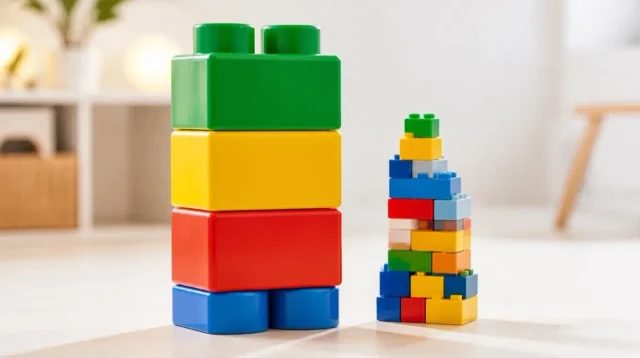
Duplo vs LEGO comes up in almost every parenting group once a toddler starts stacking bricks with real intent, and the honest answer is that there's no single birthday where it clicks over. LEGO® sets and Duplo share a company and a basic building logic (studs and tubes, snap together, pull apart), but they're built for genuinely different hands and genuinely different stages of play. Duplo bricks are roughly twice the size in every direction, which matters more than it sounds like it should.
The usual guidance says Duplo suits ages one and a half to five, and standard LEGO picks up from about four or five onward, with a wide overlap in the middle where both sit on the shelf at once. That overlap is the interesting part. Most families don't make one clean switch, they run both systems side by side for a year or two, and the real question isn't "when do we retire Duplo" so much as "when does our kid start reaching for the small stuff on their own."
We'll walk through the actual signals worth watching, what tends to go wrong when the jump happens too early, and how to handle the years where a kid genuinely wants both.
The short answer
The Duplo vs LEGO switch isn't a single milestone, it's a gradual overlap that most families handle by running both systems at once for a year or two. Watch fine motor skills and actual interest in detail rather than age alone, start the first standard set small, and don't be in a hurry to retire the Duplo bin. It usually earns its keep again anyway.
The size difference is the whole story
A standard 2x4 Duplo brick is scaled up so a stud on a Duplo piece is the same footprint as an entire 2x2 area of regular LEGO studs. That's not a small tweak, it changes what a toddler's hand and grip strength can actually manage. Regular LEGO pieces are small enough to be a genuine choking hazard for a young child, which is the real reason for the age split, not some marketing line about difficulty. Duplo isn't "easy LEGO," it's a separate system designed around the safety and dexterity of kids under about three. Once a child can reliably manipulate small objects (buttons, puzzle pieces, small utensils) without putting them straight in their mouth, the physical barrier that Duplo solves has mostly gone away, and that's the first real gate to watch for rather than a date on a calendar.
Signs your kid is ready for standard LEGO
Watch what they do with Duplo itself before you buy anything new. A kid who's still mostly interested in knocking towers down, or who wanders off after a few pieces, isn't signaling readiness, they're signaling that Duplo still has runway. The kid who's ready tends to show a few things at once: they build the same simple shape over and over and get visibly bored with it, they start asking for more detail (windows, doors, specific colors in specific spots) than Duplo sets provide, and they can sit through a short multi-step task without losing the thread. Fine motor control matters more than raw age. If your child can thread beads, stack small blocks precisely, or manage buttons and zippers on their own, their hands are probably ready for pieces a quarter the size of what they've been using. None of this needs to happen all at once, and it's fine if the interest outpaces the hands for a while.
Why the jump can go badly if you rush it
The failure mode we hear about most is a well meaning gift of a big licensed LEGO set for a just-turned-four-year-old who's still mostly building with Duplo, and it backfiring. Small pieces scatter and get lost fast, tiny elements are genuinely hard for a preschooler's fingers to separate and click into place, and a kid who can't finish the build alone tends to get frustrated rather than proud. There's also a safety piece that's worth saying plainly: LEGO's small-parts warning for kids under three exists for a real reason, and a household with a toddler sibling around loose 1x1 tiles is a different risk profile than one without. Rushing the switch doesn't usually create a lifelong LEGO hater, but it can turn what should be a confidence-building hobby into one more thing that ends in tears and a half-finished box in the closet.
The overlap years are normal, not a compromise
Most kids don't move cleanly from one system to the other, they run both at once for a while, and that's worth treating as the default plan rather than a stopgap. A five or six year old might still reach for Duplo to build fast and loose (a quick castle, a garage for a toy car) while also sitting down for twenty minutes with a small licensed set that has real assembly steps. The two systems serve different moods: Duplo is quick, forgiving, and social (easy for two kids to build together without one hoarding all the tiny pieces), while standard LEGO rewards patience and gives a kid something to point at and say they made themselves. If your kid still pulls Duplo off the shelf after they've clearly graduated to bigger sets, that's not backsliding, it's just a kid picking the right tool for a ten-minute burst of play instead of a full afternoon.
How to make the actual switch
Start smaller than you think you need to. A first standard LEGO set with a low piece count and big, chunky shapes (a simple vehicle or a small building, not a licensed showpiece with hundreds of tiny accessory pieces) gives a kid a real win without the frustration of hunting for one specific 1x1 in a pile of two hundred. Build alongside them the first couple of times rather than handing over the box and walking away. That's less about the instructions being hard to read and more about modeling the patience the hobby actually requires, sorting pieces, checking the picture, trying again when a piece goes on backward. It's also worth keeping the two systems physically separate once a kid is mixing them, since a stray Duplo piece jammed into a standard LEGO build (or the reverse) tends to cause more frustration than either system alone.
What to do with the old Duplo
Don't rush to clear it out the week the first LEGO set shows up. Duplo has a second life as open-ended building material long after a kid has moved on to standard sets, especially for imaginative play that doesn't need instructions at all, quick towers, ramps, sorting by color. It also tends to come back out the moment a younger sibling arrives, or when friends with younger kids visit. If storage space is genuinely the issue, it's usually the licensed standard sets that lose relevance first (a kid ages out of a specific movie tie-in faster than they age out of basic bricks), while a bin of plain Duplo bricks stays useful for years as a fallback for younger visitors or a rainy afternoon that calls for something low stakes.
Common questions
Is Duplo compatible with regular LEGO pieces?
Not directly stud for stud. A Duplo brick is scaled so its footprint matches a 2x2 area of standard studs, and LEGO does make a handful of transition pieces (adapter plates) meant to bridge the two systems, but you can't snap a regular 1x2 brick onto a Duplo stud the way you can within either system alone.
What age should a kid switch from Duplo to LEGO?
There's no fixed date. LEGO's own guidance points to roughly four to five as the age when standard sets become age-appropriate, but readiness depends more on fine motor skills and whether small pieces still end up in a kid's mouth than on the number on their birthday cake. Watch the kid, not the calendar.
Can Duplo and LEGO sets be displayed or played with together?
They can sit on the same shelf, but building one continuous model across both systems doesn't really work because of the size mismatch, aside from official adapter pieces. Most families keep them as separate bins and let a kid choose which one fits the mood, rather than trying to combine them into a single build.
Should I buy a licensed LEGO set for a kid's first standard set?
Probably not as the very first one. Licensed sets often pack in smaller detail pieces and higher piece counts to match the source material, which can frustrate a kid who's brand new to small bricks. A simple, chunky starter set with a low piece count tends to build more confidence before you move on to something with more personality.
Related articles
 Guide
GuideWhere to Watch LEGO Masters (US, Canada, UK, Australia)
A country-by-country guide to legally streaming LEGO Masters US and the Australian spinoff, plus the real story on the UK version and season 6.
 Guide
GuideIs the LEGO Rivendell Worth It? (Honest Take)
Rivendell is 6,181 pieces of elves, waterfalls, and Elrond's council chamber. Here's what actually makes it worth the shelf space, and who should just buy the poster instead.
 Guide
GuideLEGO Masters UK: The Original Show and What Happened to It
The UK version started it all in 2017, ran two series with no cash prize, then quietly stopped. Here's what happened.