

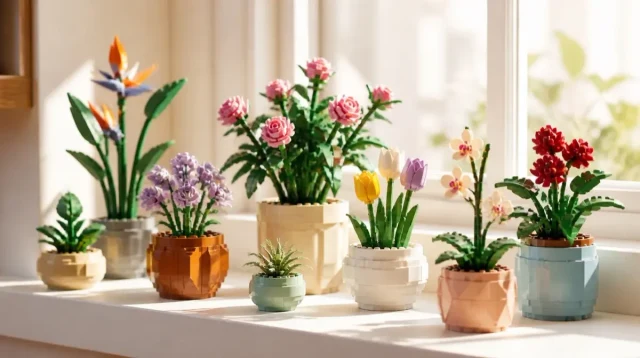
How to Display LEGO Flowers and Botanicals
The Botanicals line builds beautifully and then sits in a drawer because nobody planned where it would live. Here's how to actually display it.
The LEGO Botanicals sets (the Bonsai Tree, the Wildflower Bouquet, Succulents, the Orchid, the Flower Bouquet) sell themselves as no-water, no-dying houseplants, and that's the whole pitch. But we hear the same complaint constantly: people build one, love it for a week, then it ends up wedged on a bookshelf between other stuff where the detail disappears. If you're wondering how to display LEGO flowers so they actually read as decor and not as a toy that escaped a bin, the fix usually isn't more shelf space. It's picking the right container, the right light, and the right company for the piece.
These builds are designed to be looked at from close range. The petals are stacked in layers, the stems have real bend to them, and a lot of the botanical magic is in small color transitions that you lose entirely if the set is six feet away on a high shelf. Treat them more like a small sculpture than a knickknack and the display problem mostly solves itself.
We're not going to pretend there's one correct answer here, because a Bonsai Tree and a Succulents box want very different treatment. What follows is what actually works across the line, plus where people go wrong.
The short answer
Treat a Botanicals build like a small sculpture, not a shelf filler: bring it down to eye level, give it its own space, light it the way you'd light a real plant, and dust it more often than you'd think. Do those four things and the set finally looks like the decor it was designed to be.
Eye level beats top-shelf every time
The single biggest mistake we see is putting a finished Botanicals set on top of a bookcase or a cabinet, the way you'd store a photo frame you don't look at much. These builds have their most interesting detail between about knee height and shoulder height when you're sitting down: the layered petals on the Wildflower Bouquet, the wire-look bend in the Bonsai Tree's trunk, the shading on the Orchid's blooms. Put it above eye line and all of that becomes a silhouette, and a set that took an evening to build ends up doing the job of a plain green shape from across the room.
A console table, a desk corner, a low bookshelf, or a windowsill you actually pass by does more for these sets than a formal display case ever will. If you only have high shelving available, consider a small riser or a slim stand that brings the set forward and down rather than up, or move it to a spot lower in the room even if that spot feels less like a display shelf and more like a side table.
Before settling on a final spot, sit down where you'd normally be in that room and check the sightline from there, not from the middle of the room while standing. A lot of people default to the mantel or the top of the entertainment center because that's the traditional spot for a knickknack, and then wonder why the set never gets noticed. If your couch faces away from the mantel, that's the wrong shelf for something this detail-dependent, no matter how nice the mantel looks in general. Desks and reading nooks tend to outperform living-room shelving for exactly this reason: you're closer, seated, and looking in that direction for long stretches rather than passing through once on the way out the door.
Give each piece room to be looked at, not stored
Botanicals sets get crowded fast because they're roughly the size and shape of a small houseplant, and people display them the way they'd group actual plants: clustered together on a tray. That works for real plants, which have organic variation to tell them apart. LEGO builds from the same line share color families and proportions, so three of them jammed together on one tray tend to blur into a single busy shape instead of three distinct pieces.
Leave breathing room. A single Bonsai Tree on its own small table reads as a deliberate object. The same tree squeezed next to a Succulents box and an Orchid on one 12-inch shelf reads as clutter, even though every individual build is well made.
Light it like you would a real plant
Botanicals sets photograph and display best in the kind of soft, indirect light you'd give an actual houseplant, not under a direct overhead bulb that flattens the color. A spot near a window (out of full, constant direct sun, which can fade the ABS plastic on some brick colors over years) or under a warm desk lamp brings out the layered greens and petal colors far better than a ceiling fixture ever will.
If you're building a small display corner specifically for these sets, a cheap warm-white LED puck light aimed down at an angle does a lot of work. It's the same trick photographers use on real bouquets: side light shows texture, top-down flat light kills it.
Pick a container that doesn't fight the plastic
Some Botanicals sets (the Flower Bouquet, the Wildflower Bouquet) come with a stand meant to look like a vase, and that stand is fine on its own but starts to look toy-like fast if it's the only thing separating the build from the surface it sits on. Swapping in a real small ceramic or glass vase, one with an opening the LEGO stem base actually fits into, upgrades the whole display for the cost of a secondhand vase.
The trick is picking a container plain enough that it reads as a vase and not as a competing object. A patterned or brightly colored vase pulls focus from the brick detail. A plain white, black, or clear one lets the LEGO piece stay the star, the same logic that applies to picking a mat for a framed print.
Size matters more than people expect here too. A vase that's too wide leaves the stems looking sparse and loose, even though the actual bouquet hasn't changed. A vase closer in diameter to the stem cluster keeps the arrangement looking full and intentional, the same way a bouquet of real flowers looks better in a vase sized for it rather than one it's rattling around in. If you're not sure on sizing, bring the built set with you to a thrift store or secondhand shop and test a few before buying, since it takes thirty seconds and saves a return.
Mixing real plants with LEGO ones (it works, carefully)
A lot of people want to put their Botanicals build next to actual houseplants, since that's the whole conceit of the line. It can look great, but only if the scale and pot style are close enough that the LEGO piece doesn't read as a toy next to something clearly organic. A LEGO Succulents box next to real succulents in matching small terracotta pots reads as intentional. The same LEGO box on a huge tray of leafy real plants gets swallowed and looks like a coaster someone forgot to move.
If you go this route, keep the LEGO piece slightly forward of the real plants rather than tucked behind them, since the real ones will always have more visual movement and color variation to draw the eye first.
Dust is the real enemy here, more than most sets
Botanicals builds have more exposed surface area per square inch than almost anything else LEGO makes: layered petals, thin leaves, open stem structures. That means they collect dust faster than a solid model like a car or a building, and dust shows up worse on them because it sits visibly on top of flat leaf and petal surfaces rather than hiding in seams.
A soft, dry paintbrush (the kind sold for makeup or model painting) run gently over the leaves every few weeks keeps them looking fresh with almost no effort. If you're setting one up in a spot with airflow, like near a heating vent or a frequently opened window, plan on dusting more often than you would for a set tucked into a closed cabinet.
A can of compressed air works too for the tight spots between petals, but go easy on it. A hard blast can knock loose petals or thin leaves out of their sockets, especially on pieces that rely on a single small clip point rather than a snug fit. If a piece does pop off during cleaning, it's a quick fix to snap it back in, but it's simpler to avoid the problem with a gentler pass in the first place. Skip liquid cleaners and glass spray entirely. They can dull the plastic's finish and, worse, seep into the little gaps between stacked pieces where they won't fully dry.
When a display case actually makes sense
Not every Botanicals build needs a case, but the smaller, more delicate ones (individual stems, single Orchid blooms) benefit from one if the display spot sees a lot of foot traffic, pets, or curious kids. A basic acrylic dust cover, the kind sold for minifigure displays, is usually enough. You lose a little of the close-up texture through the plastic, but you gain protection from a stray elbow or a cat deciding the leaves look interesting.
For larger pieces like the full Botanical Garden, a case usually isn't practical or necessary. Those tend to live better out in the open on a stand of their own, since their scale already signals 'don't touch' better than a small bouquet does.
Households with cats deserve a specific word here, since we hear about this constantly. Cats treat thin plastic leaves and stems the way they treat real plant leaves: as something to bat at or chew. If a Botanicals set shares a room with a cat that's shown any interest in houseplants before, assume it will show the same interest here, and plan the placement (a closed shelf, a case, a spot the cat can't reach) accordingly rather than finding out the hard way.
Common questions
Do LEGO Botanicals sets fade in sunlight?
ABS plastic can fade over years of constant direct sun exposure, the same way any plastic decor item can. A spot with bright, indirect light or a few hours of morning sun is generally fine. Constant midday sun through an unfiltered window for years at a stretch is the scenario to avoid, especially for reds and dark greens, which tend to show fading first.
Can I display LEGO flowers outside, like on a patio?
We wouldn't recommend it as a permanent spot. These sets aren't weatherproofed, and temperature swings, humidity, and UV exposure outdoors are harder on the plastic and the color than any indoor environment. A covered porch for a photo or a party is fine for an afternoon. Leaving one out through changing weather isn't what the set is built for.
What's the best way to display multiple Botanicals sets together?
Vary the height rather than lining them up flat. A short riser or a couple of stacked books under one piece breaks up the sameness you get from several similarly sized boxes sitting at one level. Grouping by color family (all greens, or all florals) also reads more intentional than mixing every set in the line onto one shelf at once.
Do these sets need to be glued together for display?
No, and we'd avoid it. The stems and petals are designed to hold their pose through normal handling and light dusting. Gluing makes the set impossible to rebuild, repair, or rearrange later, and it isn't necessary for a stable display on a shelf, table, or in a case.
Related articles
 Guide
GuideWhere to Watch LEGO Masters (US, Canada, UK, Australia)
A country-by-country guide to legally streaming LEGO Masters US and the Australian spinoff, plus the real story on the UK version and season 6.
 Guide
GuideIs the LEGO Rivendell Worth It? (Honest Take)
Rivendell is 6,181 pieces of elves, waterfalls, and Elrond's council chamber. Here's what actually makes it worth the shelf space, and who should just buy the poster instead.
 Guide
GuideLEGO Masters UK: The Original Show and What Happened to It
The UK version started it all in 2017, ran two series with no cash prize, then quietly stopped. Here's what happened.