


Is LEGO Worth More Than Gold? The Math Behind the Meme
The claim that LEGO beats gold as an investment gets repeated constantly online. Here's what the comparison actually measures, and where it quietly falls apart.
You've probably seen the headline somewhere: is LEGO worth more than gold? It usually comes with a chart showing some retired set's resale price climbing past what an ounce of gold would have earned you over the same years, and it's a genuinely fun thing to read on a lunch break. The trouble is the chart is doing a lot of quiet work to make that comparison look clean, and most of the articles repeating it skip the part where they show their math.
We like LEGO as a hobby and we think a handful of sets really do hold value well after they're discontinued. That's a different claim from "LEGO outperforms gold," though, and it's worth pulling the two apart before you start buying sets the way you'd buy bullion. Gold is a single, liquid, endlessly fungible asset with a price that updates every second on a global market. LEGO is eight thousand different products made of plastic, most of which will never be worth more than you paid for them, sold through resale platforms with no central price feed and plenty of friction.
So let's actually work through the comparison instead of just repeating the meme. Where does the "beats gold" number come from, which sets it's actually describing, and what it leaves out.
The short answer
The "LEGO beats gold" headline is built on a real but narrow pattern: a handful of flagship retired sets, kept sealed and held for years, that genuinely posted strong resale numbers. It's not a fair description of LEGO as a whole, and it skips the storage care, damage risk, and resale friction that gold simply doesn't have. If you're buying sets you love and a few happen to hold value later, that's a nice bonus. Buying purely to beat gold is a bet on a small slice of the catalog, not the sure thing the meme implies.
Where the "LEGO beats gold" number actually comes from
The claim traces back to research (and plenty of copycat blog posts since) comparing the average secondary-market price growth of retired LEGO sets against the average annual return of gold over a similar stretch. On paper, LEGO's number came out ahead. That result got picked up, simplified, and repeated until it turned into a flat statement: LEGO beats gold. Nobody in the retelling ever seems to link back to the original methodology, which is usually a sign the number has drifted a long way from what was actually measured.
The part that gets dropped in the retelling is that an average return across a basket of retired sets isn't the same thing as what any one set, bought at any one time, actually did for the person who bought it. Averages get pulled upward by a small number of huge winners: a handful of Star Wars, Harry Potter, and Icons sets that genuinely multiplied in resale value after retirement. Most retired sets in that same basket did far less, and some lost value once the initial excitement wore off and shelf space at resellers filled up. Quoting the average without the spread is a bit like quoting the average return of "stocks" using only the stocks that happened to go up. It's not a fabricated number, exactly. It's just a number doing a lot more work than the headline lets on, and it travels a lot better as a viral graphic than it does as financial advice.
Gold's return is boring on purpose. That's the point.
Gold's whole appeal as an asset is that its long-term return is steady rather than exciting. It doesn't retire, it doesn't get discontinued, and its price doesn't depend on whether a licensed theme is still culturally relevant in five years. An ounce of gold today is chemically identical to an ounce of gold in 1990, and every ounce trades against the same global spot price no matter who's selling it. That sameness is what makes gold easy to price and easy to compare across decades in the first place.
A LEGO set isn't fungible in that way. A sealed, undamaged box of a retired set is worth something different from the same set with a crushed corner, and both are worth something different from an opened one, even if every piece is present. That variability is exactly what lets a handful of mint-condition, high-demand sets post the eye-catching gains that make it into the "beats gold" headlines, and it's also why comparing "LEGO" as a category to gold as a single instrument flattens a lot of real variance. Two sealed copies of the same set, stored differently for ten years, can end up worth noticeably different amounts, something that's simply not true of two gold coins sitting in two different vaults.
The sets that actually tend to hold up
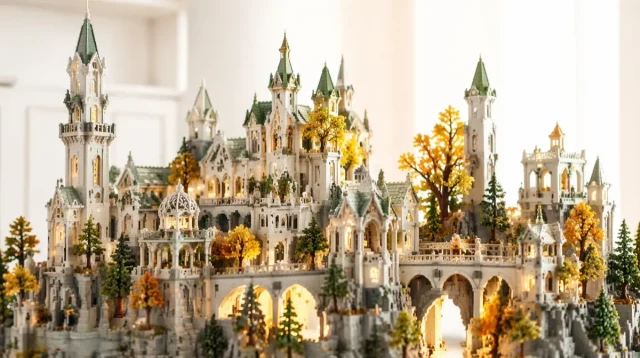
The retired sets that show up again and again in these value discussions share a few traits: large scale, a strong license or an Icons-line design pedigree, and a print run that ended while demand was still climbing. Sets like the various Millennium Falcon releases and The Lord of the Rings: Rivendell get mentioned often because they combine those traits and typically see steady interest even years after LEGO stops making them. A big, detail-heavy build with real display presence tends to hold appeal long after the last box leaves store shelves, which is a big part of why these particular lines keep coming up.
That's a narrow slice of the catalog, though. Most sets, including plenty of genuinely well-designed ones, are built in large enough numbers, or retire quietly enough, that they never develop real resale pressure. A smaller set from a licensed theme with a modest print run and no particular design pedigree can retire and simply sit at close to its original price, or below it, for years. If you're going in expecting every retired box in your closet to appreciate the way the famous examples did, the math won't back you up. We'd treat those flagship sets as the exception that got the headline, not the rule the headline implies.
The costs gold doesn't have
Gold sits in a safe deposit box or a vault and does nothing but exist. A LEGO set sitting in a closet for a decade needs to survive humidity, sunlight fading the box art, pests, and the temptation to just open it and build the thing, which instantly changes its resale category from "sealed" to "used." None of that is a hidden fee exactly, but it's real friction that a gold bar never deals with, and none of it shows up in the tidy chart comparing average returns.
Selling is friction too. Gold has dealers on every corner and a spot price you can check in seconds. Selling a LEGO set typically means listing it on a resale marketplace, waiting for a buyer, paying a platform fee, and packing a large, oddly shaped box well enough that it arrives without damage, since a dented corner can knock real money off the price. Add in the space a growing sealed-box collection takes up in a closet or a garage, which isn't free either even if nobody bills you for it directly. None of that is a reason to avoid LEGO. It's a reason to be honest that the return you see quoted online rarely accounts for the time, storage care, and selling effort it actually took to realize it.
The risk the meme leaves out entirely
LEGO doesn't publish a retirement calendar, so nobody buying a current set knows for certain when it will stop being produced, or whether it'll be one of the sets that takes off after retirement rather than one that just quietly sits on resale shelves. You're typically betting on demand that hasn't happened yet, based on patterns from sets that already retired. That's a real bet with real uncertainty, not a guaranteed multiplier, and the sets people point to as proof were picked after the fact, with the benefit of hindsight nobody had at launch.
Gold's risk profile is different: it moves with macroeconomic forces, currency strength, and investor sentiment, which is its own kind of unpredictable, but it doesn't depend on a single company's decision about which products to keep making. Comparing an asset with a centuries-long trading history to a hobby product line that's been around since the 1950s and only started getting studied as an investment in the last couple of decades is comparing two very different kinds of risk, not just two return numbers. One is a bet on macroeconomics. The other is a bet on which cardboard boxes a toy company decides to stop printing.
So, is LEGO actually worth more than gold?
For a specific handful of flagship sets, bought new, kept sealed, and held for years past retirement, the resale numbers can genuinely look better than what the same money would have earned parked in gold. That's a real, checkable pattern for those particular sets. As a blanket statement about LEGO as a category versus gold as an asset class, though, it doesn't hold up, because it's comparing a cherry-picked average against a stable benchmark and skipping the storage, damage, and liquidity costs that come with the plastic side of the comparison.
We'd frame it this way: LEGO can be a fun, occasionally lucrative hobby that happens to have investment-like upside on a few sets. Gold is a boring, liquid store of value that doesn't ask you to keep a box mint for a decade. They're not really substitutes for each other, and anyone telling you to swap one for the other in your portfolio is oversimplifying to make a better headline. If you already love the hobby, buying the sets that tend to hold value and keeping a few sealed costs you nothing you weren't already spending. Buying LEGO purely as a gold substitute is a different, much riskier bet than the meme lets on.
Common questions
Is LEGO actually a good investment?
Certain sets, typically large, licensed, or Icons-line sets that get discontinued while demand is still strong, can appreciate well after retirement. Most sets in the catalog don't see meaningful resale growth, though, so treating LEGO broadly as an investment vehicle is riskier than the best-case examples suggest. It works best as a hobby with occasional upside, not a core holding.
Which LEGO sets tend to hold their value best?
Large-scale Icons and licensed sets with strong existing fan bases, such as the various Millennium Falcon releases or The Lord of the Rings: Rivendell, are the ones that show up most often in resale value discussions. Smaller sets and ones with large print runs typically see less resale pressure once they retire.
Do LEGO sets really outperform gold on average?
Some studies comparing average retired-set resale growth to gold's average annual return have found LEGO ahead, but that average is pulled up by a small number of standout sets. Most individual sets don't post those numbers, and the comparison typically leaves out storage, condition, and resale friction, so it's not an apples-to-apples measure.
How long should I hold a set before expecting it to be worth more?
There's no fixed timeline. LEGO doesn't publish a retirement schedule, and resale value typically builds gradually in the months and years after a set stops being sold, if it builds at all. Sets bought specifically to resell are usually a multi-year bet, not a quick flip, and only a minority of sets pay off that bet.
Related articles
 Guide
GuideWhere to Watch LEGO Masters (US, Canada, UK, Australia)
A country-by-country guide to legally streaming LEGO Masters US and the Australian spinoff, plus the real story on the UK version and season 6.
 Guide
GuideIs the LEGO Rivendell Worth It? (Honest Take)
Rivendell is 6,181 pieces of elves, waterfalls, and Elrond's council chamber. Here's what actually makes it worth the shelf space, and who should just buy the poster instead.
 Guide
GuideLEGO Masters UK: The Original Show and What Happened to It
The UK version started it all in 2017, ran two series with no cash prize, then quietly stopped. Here's what happened.