

Is the LEGO Bonsai Tree Worth It? (Honest Take)
The LEGO Bonsai Tree has been one of the Botanicals line's steadiest sellers for years, and after building one, we get why. Here's who it's actually right for.
If you've spent any time browsing plant-adjacent LEGO sets, you've probably landed on the same question we get asked most: is the LEGO Bonsai Tree worth it, or is it just a nice-looking box that ends up in a drawer? The set (10281, 878 pieces) has been part of the Botanicals lineup since 2021, and it's stuck around long enough that it's clearly not a fad purchase for most people who buy it.
We've built it, displayed it, and lived with it on a shelf through a few seasons of daylight, so this is less a spec sheet and more a straight answer about where the money actually goes and who ends up glad they bought it.
Short version: it's worth it if you want a calm, satisfying build and a piece of decor that doesn't scream 'LEGO set' at guests. It's a weaker buy if you were hoping for a display piece with jaw-dropping scale, or if you already have three other plant sets doing the same job on the same shelf.
The short answer
The LEGO Bonsai Tree earns its reputation honestly: a calm, well-designed build that actually looks like decor once it's finished, not a LEGO set in disguise. Buy it for the trunk technique and the shelf presence, not for a challenge or a huge centerpiece, and it'll deliver exactly what it promises.
What you're actually paying for
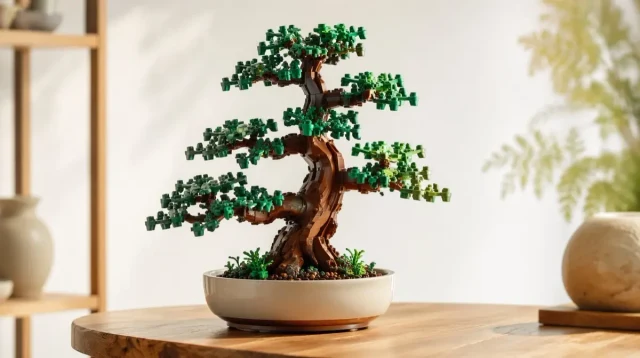
The Bonsai Tree isn't selling you a big finished model the way a Star Wars ship or a modular building does. What you're paying for is the trunk. LEGO's designers spent real effort figuring out how to fake the twist and taper of a bonsai trunk out of straight plastic elements, and the technique they landed on (stacked, angled branch pieces layered to build a curve) is genuinely clever. If you've ever tried to make a LEGO structure look organic, you know how hard that is, and this set solves it better than almost anything else in the catalog.
The second thing you're paying for is the swap. The set ships with both green leaves and pink cherry-blossom pieces, so you build the tree once and can restyle it seasonally without buying a second set. That's a real feature, not a marketing line. Plenty of buyers do actually swap the leaves twice a year.
At 878 pieces, it's also a modest footprint for the shelf space it fills. That's worth weighing against sets that hand you double the pieces for a similar price, because here the piece count isn't really the point. You're not paying for volume, you're paying for the shape those pieces end up making, and that's a different value proposition than most LEGO sets ask you to accept.
The build experience, honestly
This is not a set that tests your building skill. There's no tricky Technic linkage, no fussy sticker alignment, no 40-minute stretch of identical windows. It's closer to a craft project than a puzzle. You're placing branch segments one at a time, checking the angle against the last one, and the whole thing has a rhythm to it that a lot of builders find genuinely relaxing.
That's a selling point for some people and a letdown for others. If you want a build that pushes back, that makes you problem-solve, this one won't scratch that itch. If you want an evening where your hands are busy and your brain can wander, it delivers exactly that. Worth knowing going in, because the reviews that complain the build is 'boring' are usually reviewers who wanted a challenge and got a meditation session instead.
The instructions themselves are clear and well paced, which matters more here than in a lot of sets, since a repetitive build lives or dies on whether you can tell at a glance where the next branch goes. There's no ambiguity about which way a branch curves or how far it should lean, and that clarity is part of why the set works as a wind-down project rather than a source of frustration. Set aside a couple of hours in one sitting if you want the momentum, or split it across a few nights. Either way works, and neither feels rushed.
How it actually looks on a shelf
This is where the set earns its reputation. Most LEGO display sets look like LEGO the moment you get within a few feet of them. The Bonsai Tree is one of the rare exceptions. The pot, the trunk shape, and the leaf texture read as a stylized plant from across a room, and a lot of buyers report that guests don't clock it as a LEGO set until they're standing right next to it.
The trade-off is scale. It's a tabletop piece, not a statement centerpiece. If you're hoping for something that dominates a bookshelf the way a big Colosseum or Eiffel Tower build does, this isn't that. It's meant to sit next to a lamp or a stack of books and look like it belongs there, not to be the first thing anyone sees when they walk in.
Lighting matters more than you'd expect. In direct sun the leaf pieces can look a touch plasticky, since the texture that reads as foliage in soft indoor light goes flat and shiny under a bright window. Put it somewhere with even, indirect light and the illusion holds up. Put it on a sunny sill and you'll notice the plastic a lot faster than you'd like.
Where it falls short
The leaf-swapping feature is nice but fiddly in practice. Popping individual leaf pieces off the branches without disturbing the ones next to them takes patience, and depending on how tightly you built the branch clusters, some leaves come off easier than others. It's not hard, it's just slower than the marketing copy makes it sound.
The pot is also a little plainer than some builders expect for a set at this price point. It does the job and looks fine, but it's not where the design budget clearly went. If display presence in the pot itself matters to you as much as the tree, that's worth knowing before you commit.
Dust is the other thing nobody mentions until they've owned one for a year. The leaf clusters have a lot of small crevices, and unlike a smooth minifigure display case, there's no realistic way to dust this set without a can of compressed air or a soft brush. If it's going somewhere it'll sit untouched on a shelf for months, factor that maintenance into the decision, because it's a real part of owning the set long term.
Who this set is actually right for
It's an easy yes for anyone who wants a low-stress build with a genuinely nice result, anyone furnishing a home office or reading nook who wants something greener than another framed print, and anyone buying a gift for someone who likes plants more than they like typical LEGO franchises. It's also a strong pick if you've already built a few big licensed sets and want something quieter as a change of pace.
It's a weaker pick if you're chasing piece count or build difficulty as the main draw, or if you're buying purely as an investment play. LEGO doesn't publish a retirement calendar, so we can't tell you exactly when this one leaves shelves, but Botanicals sets have typically had solid staying power compared to some licensed lines, which cuts against the idea of buying multiples purely to resell later.
How it compares to the rest of Botanicals
Inside the Botanicals line itself, the Bonsai Tree sits in the middle in terms of both price and scale. It's bigger and more involved than something like the Orchid, which is a quicker, smaller build with fewer branch segments to place. If you're deciding between the two and want more time in the build itself, the Bonsai Tree is the better pick. If you want something faster to finish and just as photogenic in a smaller footprint, the Orchid holds its own.
If you're weighing it against a bigger showpiece set from a different theme entirely, like the Eiffel Tower or the Colosseum, understand that you're comparing two different jobs. Those sets are built to impress with scale and detail density. The Bonsai Tree is built to look like it isn't a LEGO set at all. Buying both isn't redundant the way buying two Botanicals sets in a row might start to feel.
Common questions
How long does the LEGO Bonsai Tree take to build?
Most builders report a single relaxed evening, though it depends heavily on pace. It's a repetitive, calming build rather than a technically demanding one, so speed comes down to how much you enjoy lingering over the branch placement rather than how skilled a builder you are.
Can you actually switch between the green and pink leaves?
Yes, the set includes both leaf colors so you can build it once and restyle it seasonally. The leaves clip onto the branches individually, so swapping them is doable but a bit fiddly, especially on branch clusters you built tightly. Expect it to take longer than it sounds.
Is the LEGO Bonsai Tree good for beginners?
It's one of the better beginner-friendly display sets LEGO makes. There's no tricky Technic work and no dense sticker sheet, just repeated branch placement that builds confidence without frustration. It's a reasonable starting point for someone who wants to try a LEGO botanical set before committing to a bigger build.
Is the LEGO Bonsai Tree going to be retired soon?
LEGO doesn't publish a retirement calendar, so there's no confirmed date. Botanicals sets have typically stuck around longer than trend-driven licensed sets, and this one's been a steady seller since 2021, but availability can still change without notice.
Related articles
 Guide
GuideWhere to Watch LEGO Masters (US, Canada, UK, Australia)
A country-by-country guide to legally streaming LEGO Masters US and the Australian spinoff, plus the real story on the UK version and season 6.
 Guide
GuideIs the LEGO Rivendell Worth It? (Honest Take)
Rivendell is 6,181 pieces of elves, waterfalls, and Elrond's council chamber. Here's what actually makes it worth the shelf space, and who should just buy the poster instead.
 Guide
GuideLEGO Masters UK: The Original Show and What Happened to It
The UK version started it all in 2017, ran two series with no cash prize, then quietly stopped. Here's what happened.