

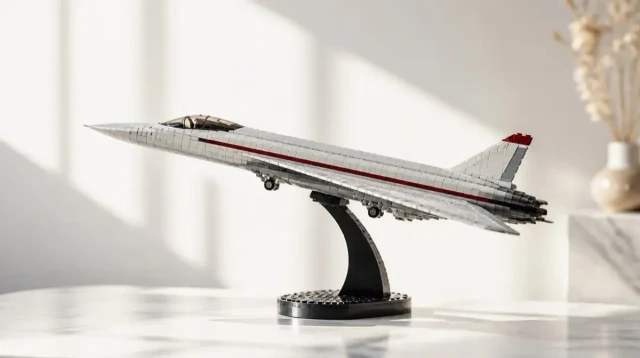
Is the LEGO Concorde Worth It? (Honest Take)
The LEGO® Concorde is a striking display piece with a real engineering story behind it, but the build itself and the shelf space it demands aren't for everyone. Here's who it actually suits.
If you're asking whether the LEGO Concorde is worth it, you've probably already seen a photo of it somewhere and felt the pull. It's a fair question to ask before you commit, because this isn't a small purchase or a small model. At 2,083 pieces and roughly a meter of finished wingspan, the Concorde is one of those Icons sets that looks completely different in person than it does on a screen, and that gap between photo and reality is exactly where buyer's remorse tends to live.
We're not going to tell you it's a must-have, because almost nothing is. What we can do is walk through what the build actually feels like, what the finished model demands of your home, and who ends up genuinely happy they bought it versus who ends up with a beautiful plane collecting dust because there was nowhere obvious to put it. That's the real question buried inside "is the LEGO Concorde worth it," and it deserves a real answer.
The short answer
The LEGO Concorde earns its reputation as a genuinely impressive engineering model, and for an adult builder who cares about aviation and has a real spot to display it, it's an easy recommendation. The catch isn't the build itself, it's the space and interest level it demands afterward. Buy it for the plane, not for the photo, and measure your shelf before you measure your enthusiasm.
What you're actually building
The Concorde belongs to LEGO's Icons line, which means it's aimed squarely at adult builders rather than kids, and the instructions treat you accordingly. There's no hand-holding narrative here, just a long, methodical construction of a fuselage, a delta wing built in sections, and a set of four engine nacelles that get attached late in the process. The build leans heavily on Technic connections hidden inside the body to keep that long, thin fuselage from sagging under its own weight, which is a smart piece of engineering even if it means a fair number of steps feel more structural than satisfying.
At 2,083 pieces, it's a multi-session build rather than an afternoon project. Expect the wing assembly to be the part that tests your patience most, since it's repetitive and doesn't visually change much between steps, while the nose section and the distinctive drooping design (a real feature of the actual aircraft) are the moments that feel like a payoff. If you enjoy builds that reward precision and produce a genuinely accurate model of something real, this delivers. If you build for that steady dopamine hit of watching a shape emerge quickly, the middle third will drag.
The color palette is another thing worth knowing going in. Most of the fuselage relies on white and light bluish gray elements in fairly plain, flat panels, which is accurate to the real aircraft but means long stretches of the build don't introduce much new visually. Builders who like a set that keeps surprising them piece by piece should go in with the right expectations. Builders who like watching an accurate, large scale shape take form slowly will find that same plainness satisfying rather than dull.
How it compares to other big Icons vehicles
If you've built other large-scale Icons sets, like a ship or a classic car, the Concorde sits at a similar overall size but with a different kind of challenge. Boxier vehicle sets tend to build in a way that feels sturdy from the first few steps, since you're stacking a chassis and adding to it. The Concorde spends a lot of its early build on long, thin sub-assemblies that don't feel especially solid until they're joined to the rest of the fuselage near the end, which can be a little unnerving if you're used to sets that feel finished-feeling at every stage.
It's also less of a "parts pack" set than some other large builds, meaning you won't come away with a huge surplus of generic bricks and plates useful for other projects. Most of the piece count goes into specialized wedge plates and panels shaped for this exact model. That's fine if you're buying it purely to build and display the Concorde, but worth knowing if part of your usual calculation is how useful the leftover parts bin will be afterward.
The engineering story is the real selling point
What separates the Concorde from a lot of other big display sets is that it's not just a pretty shape scaled up in brick form. The model reproduces the plane's actual proportions and its signature nose-droop mechanism, and the set includes background on the aircraft's design and its short, storied life in commercial service. For anyone with even a passing interest in aviation, that context turns the build from "assemble a plane" into something closer to a model kit with real history attached, and it's a big part of why this set tends to land well as a gift for aviation enthusiasts specifically, rather than LEGO fans in general.
That historical angle also explains some of the design choices that might otherwise seem odd, like the amount of internal structure dedicated to keeping that long nose from drooping on its own when you don't want it to. It's a detail that only matters if you already care about the plane, which is worth knowing before you buy this for someone who just thinks planes are neat in the abstract.
Display space is the real cost
This is the part that catches people off guard. The finished Concorde is long and thin, with a wingspan that makes it awkward to shelve next to other Icons sets. It doesn't fit neatly into a bookcase the way a boxier model does, and the included display stand holds it at an angle that needs real depth in front of it, not just width. If you're picturing it on a mantel or a narrow shelf, measure first. We've seen this exact problem sink otherwise happy owners of large vehicle sets: the build goes great, and then the finished model spends its life on a dining table because there was never a real plan for where it would live.
If you have a defined spot for it, a media console, a dedicated shelf, a desk with some breathing room, this stops being an issue and becomes a feature. A well-lit Concorde on its stand is a genuinely striking object. The honest advice is to solve the space question before you solve the budget question, because an unhoused giant plane is a worse outcome than not buying it at all.
Who this set is actually for
The clearest yes here is the adult builder who already likes long, technical builds and has a specific fondness for aviation, aerospace, or transportation history. If you've built other Icons vehicles and enjoyed the process more than the play value, you know what you're signing up for. It's also a strong pick as a milestone gift, a retirement present, a big birthday, something with real weight behind the gesture, provided the recipient has both the patience for a long build and the room to display the result.
The clearer no is anyone shopping for a kid, anyone who wants a fast, satisfying build in a weekend, or anyone buying purely because the set looks cool in photos without having thought about where it goes afterward. It's also not the set to buy someone who likes LEGO in general but has no particular pull toward aircraft. The history and engineering detail are wasted on a buyer who's just there for the brick count.
The retirement question
LEGO doesn't publish a retirement calendar, so anyone telling you exactly when a set will disappear is guessing. What we can say is that Icons sets in this scale and price range typically stay available for a few years before they're phased out, and licensed or historically significant vehicle sets like this one have tended to hold their value reasonably well after retirement, since demand from collectors and enthusiasts doesn't dry up the way it does for more generic sets. That's a pattern, not a promise.
If you're on the fence and worried about missing out, that worry is understandable but shouldn't be the deciding factor. Buy it because you want to build it and have somewhere to put it, not because you're afraid of a future price increase that may or may not happen. Sets bought purely on retirement anxiety are the ones most likely to sit unbuilt in a closet.
Where it falls short
The middle stretch of the wing build is genuinely repetitive, and if you're the kind of builder who wants variety step to step, it's worth knowing that going in. The finished model, while accurate, is also fairly delicate along that long fuselage. It's not a set you want to move around often or store somewhere it might get knocked, and the display stand, while functional, isn't going to disguise the fact that this needs a permanent home rather than a temporary one.
There's also the simple reality that this is a niche interest set dressed up as a mainstream showpiece. It photographs beautifully, which drives a lot of impulse interest, but the actual ownership experience rewards people who care about the subject matter specifically. That's not a flaw exactly, more a mismatch that happens when a set becomes an internet-famous image before people slow down and ask whether they'd actually enjoy owning it.
Common questions
How long does the LEGO Concorde take to build?
Expect several sittings rather than one afternoon. The wing sections in particular are repetitive and best tackled in shorter stretches rather than all at once. Builders who enjoy long, methodical projects tend to find the pace comfortable, while those looking for a quick weekend build should expect this one to take longer than a similarly priced set with more varied steps.
Is the LEGO Concorde good for display or does it need to be stored?
It's designed as a display piece and comes with a stand, but its long, narrow shape means it needs real shelf depth and a spot where it won't get bumped. It's not a set you build and then tuck away. Plan the display location before you buy it, since a lack of appropriate space is the most common regret owners report.
Is the LEGO Concorde a good gift?
It's a strong gift for someone who already has an interest in aviation or aerospace history and enjoys long, technical builds, especially for a milestone occasion. It's a weaker gift for a general LEGO fan with no particular pull toward planes, or for a kid, since the build style and piece count skew firmly toward experienced adult builders.
Will the LEGO Concorde get retired soon?
LEGO doesn't publish retirement dates, so there's no way to know for certain. Icons sets in this range typically stay in production for a few years, and sets tied to real historical vehicles have generally held up reasonably well in the secondary market after retirement, though that's a pattern based on past sets, not a guarantee for this one.
Related articles
 Guide
GuideWhere to Watch LEGO Masters (US, Canada, UK, Australia)
A country-by-country guide to legally streaming LEGO Masters US and the Australian spinoff, plus the real story on the UK version and season 6.
 Guide
GuideIs the LEGO Rivendell Worth It? (Honest Take)
Rivendell is 6,181 pieces of elves, waterfalls, and Elrond's council chamber. Here's what actually makes it worth the shelf space, and who should just buy the poster instead.
 Guide
GuideLEGO Masters UK: The Original Show and What Happened to It
The UK version started it all in 2017, ran two series with no cash prize, then quietly stopped. Here's what happened.