

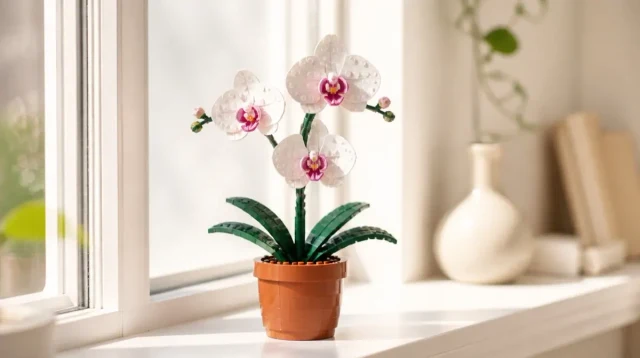
Is the LEGO Orchid Worth It? (Honest Take)
A plant that never needs watering and never drops a petal. Here's what actually makes the LEGO Orchid worth building, and who should skip it.
If you've spent any time near a LEGO Botanicals display, you've probably wondered: is the LEGO Orchid worth it, or is it just a nicely photographed box of plastic leaves? It's a fair question. The Orchid (set 10311) sits in that odd space between houseplant and hobby, and it costs more than a real orchid from the grocery store that would, admittedly, eventually die. We've built it, displayed it, and moved it between three different shelves trying to find its best light. Here's the honest version of what you're paying for.
The short answer is that it earns its keep if you actually want a plant on a shelf and don't want to keep one alive. The longer answer depends on what you're comparing it to: a real plant, a different LEGO Botanicals set, or just a candle and a framed print. We'll walk through the build, the display case, the price question, and who this is actually for.
The short answer
The LEGO Orchid earns its price if you actually want the outcome it's selling: a calm build and a permanent plant that looks good on a shelf. It's not trying to be the most exciting set in the catalog, and it isn't. If that trade sounds appealing, it's an easy yes. If you're shopping for a kid or want a bigger technical challenge, look elsewhere in the catalog first.
What you're actually building
The Orchid comes in at 608 pieces, which puts it in a comfortable evening-or-two range rather than a weekend project. You're building a stem, a cluster of blooms in a color of your choosing (the set typically ships with two petal color options so you can pick which one goes on display), and a woven-look basket planter that's more clever than it looks in photos. The technique used for the petals is the same layered-plate approach LEGO uses across the Botanicals line, and it holds up here. Nothing about the build feels padded. There's no filler subassembly just to bulk up the piece count, which is more than you can say for some sets in this price range.
Worth noting: because the flower color is your choice at build time rather than fixed, you end up with a small design decision baked into an otherwise instruction-led build. It's a nice touch. It also means two people building the same box can end up with two different looking plants on their shelves, which is a fun detail if you're building this as a gift or alongside a friend.
The build experience, honestly
This isn't a fiddly, frustrating build, but it also isn't mindless. The stem sections require some patience to get the curve looking natural rather than stiff, and the leaves use a stacking technique that rewards going slow. If you're building this to unwind after work, it delivers. If you're building it because you want a project that takes all weekend, it won't, at least not on its own. Pair it with another Botanicals set if you want a longer session. The instructions are clean and never leave you guessing, which matters more here than in a vehicle set, since there's no obvious mechanical logic to fall back on if you lose your place.
The sticker sheet situation here is minimal to nonexistent, which is a relief if you've built other display sets and gotten stuck aligning a decal on a curved surface. Most of what makes this set look finished comes from piece choice and color, not printed or stickered detail, so there's less room to mess up the final look. That's a real point in its favor if you've been burned by fiddly sticker placement before.
How it actually displays
This is where the Orchid either wins you over or doesn't. Displayed on its own on a bookshelf or desk, it reads as a real plant from a few feet away, which is the whole point. Up close, you can tell it's LEGO, and that's fine. The basket planter is a nice touch that a lot of competing plant sets skip, and it means you don't need to buy or find a separate pot. Where it struggles is in a room with a lot of visual clutter already. It doesn't have the presence of a bigger, more colorful build, so it works best somewhere with a bit of breathing room around it: a windowsill, a clear corner of a desk, a shelf that isn't already crowded.
Lighting matters more than you'd expect. In a dim corner, the petal color reads flat and the whole thing loses the effect it's going for. Put it somewhere it catches a bit of natural light during the day and the difference is noticeable. If you're buying this specifically as a replacement for a real plant on a windowsill, that's actually the best possible spot for it, since it gets the light without any of the watering or wilting a real plant would need.
Is the price fair for what you get
We're not going to guess at a specific number here since LEGO pricing shifts and varies by region and retailer, but the general read is this: you're paying a premium over a standard set at a similar piece count, and that premium is for the display-plant category itself, not for anything unusual in the build complexity. If you're comparing it dollar for piece against a Star Wars or Technic set, it'll look expensive. If you're comparing it to actual home decor (a nice vase, a faux plant from a home goods store, a framed botanical print), it starts to look reasonable, especially since it doubles as something you build first and display after.
The real comparison worth making is against a live orchid from a nursery or grocery store. Those need repotting, the right light, and careful watering, and plenty of them don't make it a year in a normal household. The LEGO version costs more up front and never blooms twice, but it also never dies, never gets overwatered, and never needs anything from you once it's built. Whether that trade is worth it depends entirely on whether you actually want a plant or just want the look of one.
Who this set is actually for
The Orchid is a strong pick for adult builders who want a low-key, satisfying evening project and a piece of decor at the end of it, for someone furnishing a first apartment or office who wants something with more personality than a poster, and for anyone who has genuinely killed every houseplant they've ever owned. It's a weaker pick if you're shopping for a kid (the color-swap petals and quiet build pace don't hold most kids' attention the way a vehicle or minifigure-heavy set does), or if you already have several Botanicals sets and are looking for something that pushes the format somewhere new. It plays it safe rather than reinventing what came before it.
It's also a solid gift for someone you don't know the exact taste of. A vehicle set or a licensed theme set requires knowing what franchise someone actually likes. A well-built plant for the shelf is close to universally welcome, especially for a coworker, a new homeowner, or a relative who's hard to shop for. That's a quieter kind of value than raw piece count or build complexity, but it's real.
How it compares to the rest of Botanicals
If you're choosing between sets in this line, piece count and finished size are usually the deciding factors, along with which flower or plant actually matches your taste (that one matters more than people expect, since you're going to look at this thing daily). The Orchid sits in the middle of the range: not the smallest or cheapest option, not the largest showpiece either. If you want something faster to build, look at the smaller entries in the line. If you want a bigger statement piece for a shelf, there are larger Botanicals builds that take longer and display bigger. The Orchid's advantage is that it hits a sweet spot of build time versus display payoff without asking for a huge chunk of shelf space in return.
The orchid flower itself also has a specific look and reputation, elegant, a little formal, the kind of plant people associate with an office reception desk or a nicer hotel lobby. If that's the look you want, this is the obvious pick in the line. If you'd rather have something more casual or colorful, one of the other Botanicals entries will suit the room better than forcing this one to fit.
The honest verdict
We like this set. It's not the most technically impressive build LEGO has ever put out, and it won't wow a room the way a big Icons set does, but it does exactly what it says it will do: give you a plant that looks good, never needs water, and never drops a leaf on the carpet. The build is calm rather than thrilling, which is either a feature or a drawback depending on what kind of evening you're looking for. If the idea of a permanent, no-maintenance plant appeals to you at all, this is one of the better ways LEGO has found to deliver that.
Common questions
How long does the LEGO Orchid take to build?
Most builders get through it in one longer sitting or two shorter ones. At 608 pieces it's not a marathon build, but the stem and leaf sections reward going slowly rather than rushing, so budget an evening rather than an hour.
Does the LEGO Orchid come with a pot or planter?
Yes, the set includes a basket-style planter built from the same pieces, so you're not left needing to source your own display container. It's part of what makes the finished piece feel complete rather than like a bare stem you have to style yourself.
Is the LEGO Orchid good for beginners?
It's approachable for anyone with a little building experience, but the stacked leaf and stem techniques aren't quite as simple as a basic brick build. A first-time builder can manage it, though a set with more straightforward instructions might be a gentler starting point.
Will the LEGO Orchid get discontinued or retired?
LEGO doesn't publish a retirement calendar, so there's no official date to point to. Botanicals sets have typically had solid runs compared to some licensed themes, but if you've been eyeing this one for a while, it's worth checking current availability rather than assuming it'll be around indefinitely.
Related articles
 Guide
GuideWhere to Watch LEGO Masters (US, Canada, UK, Australia)
A country-by-country guide to legally streaming LEGO Masters US and the Australian spinoff, plus the real story on the UK version and season 6.
 Guide
GuideIs the LEGO Rivendell Worth It? (Honest Take)
Rivendell is 6,181 pieces of elves, waterfalls, and Elrond's council chamber. Here's what actually makes it worth the shelf space, and who should just buy the poster instead.
 Guide
GuideLEGO Masters UK: The Original Show and What Happened to It
The UK version started it all in 2017, ran two series with no cash prize, then quietly stopped. Here's what happened.