

Is the LEGO Polaroid Camera Worth It? (Honest Take)
The LEGO Polaroid OneStep SX-70 is a 516-piece display piece with a real trick up its sleeve. Here's who it's actually for.
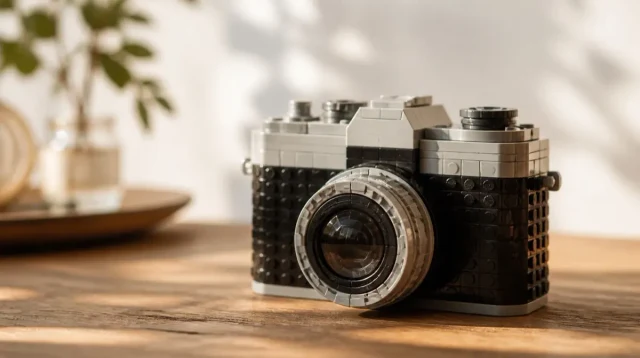
If you've searched "is the LEGO Polaroid camera worth it," you've probably already seen the photos: a chunky, retro camera body in cream and rust orange, with a strap and a viewfinder and even a printed photo popping out the front. The LEGO Polaroid OneStep SX-70 (set 21345) is one of those LEGO Ideas sets that gets pointed at non-builders as proof the hobby isn't just spaceships and castles, and on looks alone it earns that reputation. The question is whether the build underneath the nostalgia holds up, and whether 516 pieces of camera is a smart way to spend your money and your shelf space.
We've built enough of these smaller Ideas sets to know the pattern: a clever central mechanism, a short build time, and a price that can feel steep once you do the piece-count math against a bigger set. The Polaroid mostly avoids the trap because the mechanism is the whole point, not an afterthought bolted onto generic bricks. But it's also a narrower set than it looks in photos, and it's worth being clear about who should buy it and who'll be happier spending the same money elsewhere.
The short answer
The LEGO Polaroid OneStep SX-70 is a small, well-designed build that photographs better than almost anything else on our shelves, and the photo-eject mechanism is worth the price of admission on its own. It's not a deep, technical build and it's not a toy for kids, so go in knowing you're buying a fast, satisfying evening and a great-looking display piece, not a weekend project. For the right person, that trade is an easy yes.
What you're actually building
The LEGO Polaroid OneStep SX-70 is built at roughly 1.7 scale, big enough to feel substantial on a shelf without turning into a coffee-table centerpiece. At 516 pieces, it's a modest build by LEGO Ideas standards, the kind of thing you finish in an evening rather than spread across a weekend. Most of the piece count goes toward the camera body itself: the cream shell, the rust-colored trim, the lens housing, and the leather-textured strap panel. There's a real viewfinder you can look through, a shutter button that clicks, and a slot where a printed 'photo' brick slides out the front when you press the top. That last part is the reason this set exists. It's a genuinely satisfying bit of engineering for something built entirely out of studs and plates, and it's the moment that sells the set to anyone watching you build it.
The rest of the model is dedicated to getting the proportions right, which sounds like a small thing until you realize how easy it would be to make a blocky camera look like a brick with a lens stuck on. The designers clearly spent real effort curving the corners, angling the lens ring, and getting the shutter button to sit proud of the body the way it does on the real thing. Even the strap has a woven texture to it built from alternating plates, which is a small detail that a lot of builders wouldn't notice consciously but would definitely notice if it were missing.
The build experience
This isn't a technique showcase in the way some Ideas sets are. There's no elaborate gearing or hidden Technic core running the length of the model. Instead, the design leans on a simple lever-and-slide mechanism for the photo ejection, dressed up with careful color blocking so the finished camera reads as a single, cohesive object rather than a pile of bricks wearing a costume. The early stages are straightforward stacking, which some builders find a little slow to start, but the pace picks up once you reach the lens assembly and the ejection mechanism, where the instructions start rewarding attention rather than just following steps. It's a good build for someone newer to LEGO Ideas sets, since nothing here demands prior experience with tricky SNOT (studs not on top) work or fiddly small-part assembly.
Build time lands around an hour and a half to two hours for most builders, which makes this a genuinely good weeknight project rather than something you have to carve out a whole Saturday for. The instruction booklet is clean and the bag numbering keeps the parts organized, so you're not hunting through a pile of loose pieces trying to find the one cream-colored 1x2 plate you need. If you're building with a kid or a partner who isn't a regular LEGO builder, this is a friendly enough set to hand off sections of without either of you getting frustrated, and the payoff at the end (pressing that shutter for the first time) works as a genuinely fun moment to share.
How it looks on a shelf
This is where the set earns its keep. The finished camera photographs beautifully, which explains why it shows up constantly in gift guides and 'cool LEGO sets' roundups. It sits well on a bookshelf, a desk, or next to an actual vintage camera collection, and the strap detail gives it a nice sense of having weight and purpose rather than looking like a toy. It doesn't light up and it doesn't have a play function beyond the photo-eject gimmick, so once the novelty of pressing that shutter a dozen times wears off, it settles into being a display piece. That's fine if display is what you want from it. It's worth knowing going in if you were hoping for something more interactive.
One detail worth calling out is scale. In photos, the set can look almost life size, and that expectation trips a few buyers up when the box arrives. It's larger than a real Polaroid camera but still compact enough to sit comfortably on a standard shelf or desk without hogging the whole surface. If you're picturing something you could pass around a room the way you would the real thing, temper that a little. It reads best displayed at eye level, ideally with a bit of breathing room around it rather than crammed between other sets, since the clean shape is part of what makes it work as a piece of decor.
Who this set is actually for
The sweet spot here is photography fans, design nerds, and anyone who has a soft spot for the actual Polaroid SX-70 or the wider instant-camera era. It also works well as a gift for someone who doesn't build LEGO regularly but would enjoy a short, satisfying project with a fun payoff at the end, since the piece count and build time don't demand much of a time commitment. It's a weaker pick for a serious LEGO Technic or Creator Expert builder who wants a long, technically demanding evening, since this one is over quicker than its shelf presence suggests. If you're shopping for a kid, this one skews adult in its appeal. The color palette and retro subject matter land better with grown-ups who remember Polaroids, or who just appreciate the design language, than with younger builders looking for something to play with.
It's also worth thinking about who you're buying it for versus who you'd be buying it as. A lot of these Ideas sets end up purchased by one adult for another adult who has a specific niche interest (film photography, mid-century design, vintage tech) rather than for a general LEGO fan on your list. If the person you're shopping for already owns a real vintage camera or two, or follows photography accounts, this lands a lot harder than it would with someone who just likes building things in general. Conversely, if you're buying for yourself and you already have a wall of Ideas sets, this one slots in nicely as a smaller, quicker addition between bigger projects.
Where it sits against other LEGO Ideas sets
LEGO Ideas sets typically run from small novelty builds up through large, multi-thousand-piece showpieces, and the Polaroid sits firmly on the smaller end of that range. That's not a knock, since not every Ideas set needs to be a weekend project, but it does mean the per-piece cost tends to run higher than you'd see on a bigger set in the same line, simply because you're paying for the design and the license as much as the brick count. If your priority is pure build time for the money, a larger Ideas set will usually get you more hours. If your priority is a distinctive, conversation-starting object that took an evening to build, the Polaroid does that job well. It's also one of the more approachable Ideas sets for someone easing into the line, since it doesn't ask for the patience that the biggest sets do.
The retirement question
LEGO doesn't publish a retirement calendar, so we can't tell you an exact date this set will disappear from shelves. What we can say is that LEGO Ideas sets typically have a defined run before they're phased out, and licensed nostalgia pieces like this one have historically been reported as popular gift-season sellers, which tends to shorten their shelf life once a set catches on. If you've been sitting on the fence about this one and it fits your budget now, we wouldn't bank on it being easy to find at retail a year or two from now. That's a general pattern across LEGO Ideas releases, not a guarantee about this specific set.
It's also worth checking your local retailer's stock before assuming it's readily available everywhere. Ideas sets sometimes sell through faster at smaller retailers than at LEGO's own stores, and a set that looks perpetually in stock online can still be the kind of thing that quietly disappears from shelves for a season before a restock. If you're set on this one, buying when you see it rather than waiting for a sale is usually the safer move with this line of sets.
Common questions
How many pieces are in the LEGO Polaroid camera set?
The LEGO Polaroid OneStep SX-70 (set 21345) has 516 pieces. That puts it on the smaller side for a LEGO Ideas release, and it typically builds in a single sitting rather than spread across several evenings.
Does the LEGO Polaroid camera actually do anything?
Yes, in a limited way. Press the shutter button and a printed 'photo' brick slides out of the front slot, mimicking an instant camera ejecting a print. There's also a real viewfinder you can look through. Beyond that mechanism, it's a static display model with no lights or motorized parts.
Is the LEGO Polaroid camera a good gift?
It's a strong gift for adults who like photography, retro design, or short, satisfying builds, since the build is quick and the payoff (the photo-eject mechanism) is genuinely fun to show off. It's a weaker choice for kids or for builders who specifically want a long, technical project.
Is the LEGO Polaroid camera worth it compared to other LEGO Ideas sets?
It depends what you're optimizing for. Larger LEGO Ideas sets typically offer more build time and a lower cost per piece, but the Polaroid delivers a distinctive display object and a clever mechanism in a shorter, easier build. If shelf appeal and a quick project matter more to you than raw piece count, it holds up well against the rest of the line.
Related articles
 Guide
GuideWhere to Watch LEGO Masters (US, Canada, UK, Australia)
A country-by-country guide to legally streaming LEGO Masters US and the Australian spinoff, plus the real story on the UK version and season 6.
 Guide
GuideIs the LEGO Rivendell Worth It? (Honest Take)
Rivendell is 6,181 pieces of elves, waterfalls, and Elrond's council chamber. Here's what actually makes it worth the shelf space, and who should just buy the poster instead.
 Guide
GuideLEGO Masters UK: The Original Show and What Happened to It
The UK version started it all in 2017, ran two series with no cash prize, then quietly stopped. Here's what happened.