

LEGO Piece Count vs Price: What You Are Really Paying For
Cost per piece is a handy shortcut when you're comparing two boxes on a shelf, but it hides more than it tells you. Here's what actually moves the number.
Every LEGO fan eventually does the math: take the price, divide by the piece count, and see how the number stacks up against the last set you bought. It's a reasonable instinct. Lego price per piece is one of the few apples-to-apples numbers available in a hobby where box size, theme, and licensing fees all pull in different directions. The trouble is that the number flattens a lot of real differences into one decimal, and a set that looks like a bad deal on paper can be the better purchase once you actually open the box.
We like this metric as a rough sanity check, not a verdict. A set sitting well above the average for its theme isn't automatically overpriced, and one sitting below it isn't automatically a bargain. The parts inside the box, the license on the front of it, and what you actually plan to do with it once it's built all matter more than the ratio does. This guide walks through what drives the number up or down, so the next time you're standing in an aisle doing the math in your head, you know what you're actually looking at.
The short answer
Price per piece is a decent first filter and a poor final answer. Licensing, part complexity, and packaging all move the number in ways that have nothing to do with how good a set actually is to build or display. Use the ratio to narrow your options, then let the actual parts list and your own taste make the final call.
Why the shortcut caught on
Cost per piece spread because it's the only number you can pull off a box without any specialist knowledge. You don't need to know a theme's reputation or a designer's track record. You just need a calculator. For basic brick sets built mostly from common elements, it works reasonably well as a comparison tool, because a 4x2 brick costs roughly the same to produce whether it ships in a City set or a Creator set. Once you move outside that narrow lane, though, the number starts measuring something closer to "how many individual objects came in this box" than "how much value is inside it," and those aren't the same question.
What the ratio hides
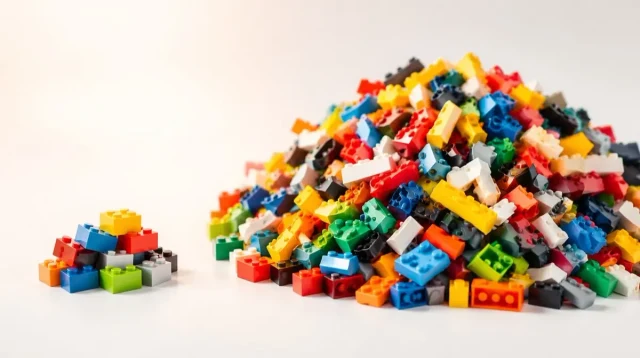
A thousand identical 1x1 plates and a thousand mixed pieces that include printed tiles, specialty brackets, and a couple of large curved panels will show up as the same piece count, but they aren't remotely the same set to produce or to build. The ratio treats every piece as equal, when in practice a handful of complex elements can cost more to mold and finish than a hundred basic bricks combined. That's before you even get to what the pieces actually do: a set padded with plates and 1x1 round tiles will feel thin in the hand next to a set with the same count built from technic pins, printed elements, and larger structural pieces.
Licensed sets play a different game
Anything with a studio's name on the box, whether that's a film franchise, a game, or a brand, carries a licensing fee that has nothing to do with plastic. That cost gets folded into the retail price, which is why licensed sets typically run higher per piece than an equivalent in-house theme like City or Creator. This isn't a hidden markup so much as the plain cost of putting a recognizable character or vehicle on the shelf. If you're comparing a Star Wars set against a Creator set of similar size, you're not really comparing plastic to plastic. You're comparing plastic-plus-license to plastic alone, and the per-piece number will always tilt toward the license.
Big, simple pieces move the average both ways
Baseplates, large curved panels, and other big-format elements lower the piece count without lowering the amount of plastic in the box, which pushes the per-piece price up even though you're getting a physically substantial set. This shows up constantly in vehicle and building sets that lean on large panel pieces for smooth exterior surfaces. The flip side happens with minifigure-heavy sets: extra figures and their accessories add pieces quickly without adding much bulk, which can pull the average down and make the set look like better value than it actually feels once it's on the shelf.
You're paying for more than plastic
Box art, printed instruction booklets, packaging that has to survive a warehouse and a delivery van, and the sheer logistics of getting a set onto shelves worldwide are all baked into the price before a single piece gets counted. A set with a thick instruction book, printed on good paper with clear diagrams, costs more to produce than a thin one, even if the piece counts match. None of this is a scandal. It's just worth remembering that the box in your hands includes real production and distribution costs that have nothing to do with the bricks themselves, and the per-piece math never sees any of it.
When a higher number is still the right call
A set with a high price per piece can be the better buy if the pieces inside it are ones you'd otherwise have to hunt down individually, if the model displays better than its part count suggests, or if it's simply the set you actually want to build. We'd rather see someone pay a bit more per piece for a set with a design they love than chase the lowest ratio and end up with a model that photographs fine but bores them by the second evening of building. Piece count and price per piece are useful filters for narrowing a shortlist. They're a poor way to pick the actual winner off that list.
A quicker way to size up a set
Before you lean on the ratio, look at what's actually in the box. Check whether the set is licensed, since that alone explains most of the gap between it and an in-house theme. Look at the parts list if one is available and see how many large or specialty pieces are in the mix versus basic bricks and plates. And think about what you actually want out of the set: a display piece that needs to look right from three feet away, or a build you want to enjoy for a weekend. Once you weigh those, the per-piece number becomes a footnote instead of the deciding factor, which is exactly where it belongs.
Common questions
Is a lower price per piece always a better deal?
Not necessarily. A low ratio often means the set is padded with small, simple pieces like 1x1 plates and tiles, which build up a piece count quickly without adding much substance. A set with a slightly higher ratio but fewer, larger, more structural pieces can feel like the better build even though the math looks worse on paper.
Why are licensed LEGO sets more expensive per piece than City or Creator sets?
Licensed sets carry a fee paid to the studio or brand behind the theme, and that cost gets built into the retail price alongside the actual production cost of the pieces. It's typically the single biggest reason licensed sets run higher per piece than comparable in-house themes, rather than any difference in the plastic itself.
Does a set's price per piece change after it's retired?
Retail price per piece is usually fixed while a set is in production, but aftermarket prices can move once a set is reported as retired, since LEGO doesn't publish a retirement calendar and demand shifts as sets become harder to find. Expect more variation on the secondary market than on the shelf.
What's a reasonable way to compare two sets in the same theme?
Compare price per piece within the same theme and rough size range, not across themes, since that at least controls for licensing costs. Then look past the ratio to what the pieces actually are: specialty elements, printed pieces, and larger structural parts add real value that a flat piece count won't show you.
Related articles
 Guide
GuideWhere to Watch LEGO Masters (US, Canada, UK, Australia)
A country-by-country guide to legally streaming LEGO Masters US and the Australian spinoff, plus the real story on the UK version and season 6.
 Guide
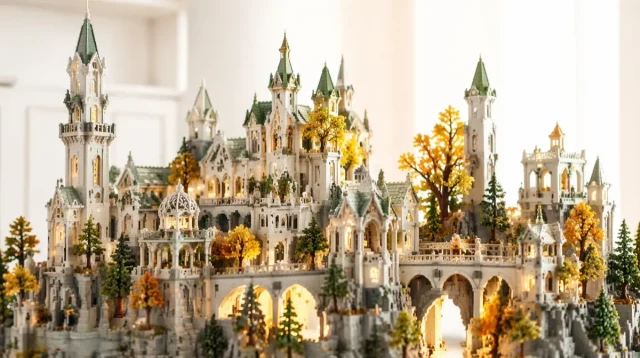
GuideIs the LEGO Rivendell Worth It? (Honest Take)
Rivendell is 6,181 pieces of elves, waterfalls, and Elrond's council chamber. Here's what actually makes it worth the shelf space, and who should just buy the poster instead.
 Guide
GuideLEGO Masters UK: The Original Show and What Happened to It
The UK version started it all in 2017, ran two series with no cash prize, then quietly stopped. Here's what happened.