

LEGO Storage Ideas for Small Spaces
You don't need a spare room to keep a LEGO collection organized. Here's how to store, sort, and display sets when floor space and shelf space are both tight.
Most LEGO storage ideas online assume you have a basement, a dedicated hobby room, or at least a wall you can dedicate entirely to bins. If you're building in a studio apartment, a shared kid's bedroom, or a living room that also has to function as, well, a living room, that advice doesn't help much. Small spaces need a different set of rules: fewer bins, more stacking, and a real answer for where finished builds actually go once the shelf fills up.
The good news is that a tight footprint forces some genuinely better habits. Sprawling collections in big houses often end up as one enormous bin nobody wants to dig through. A small space pushes you toward smaller, labeled containers and a one-in-one-out approach to displayed sets, both of which make the whole collection easier to actually use, not just store.
This guide covers loose piece storage, minifigure storage, and what to do with completed builds when your display space maxes out well before your collection does.
The short answer
A small space doesn't rule out a serious LEGO collection, it just changes the priorities. Sort by type and frequency, use vertical storage over floor space, and treat your display shelf as a rotation instead of a permanent home for every set you've ever built.
Start with vertical space, not floor space
In a small room, floor space is the first thing to run out and the last thing you should spend on LEGO storage. A stack of under-bed bins works, but it also means you're on your knees every time you need a part, which gets old fast. Look up instead. A narrow bookshelf that runs to the ceiling holds more sorted storage than a wide, low dresser in a fraction of the footprint, and it keeps parts off the floor where they get stepped on.
Stackable drawer towers are the other vertical option worth considering. They're taller than they are wide, so they tuck into a corner or a closet gap that a normal storage bin never would, and most stack cleanly enough that you can add a new tower later without redoing the whole setup. If you're renting and can't drill shelves into a wall, a stacking tower is also the safer bet since it's freestanding.
Wall space counts too, and it's the storage most small rooms leave completely empty. A shallow floating shelf above a desk holds more finished builds than you'd think, and a pegboard mounted beside a closet can hold small parts bins, a minifigure rail, or even a spool of the clear elastic string some builders use to hang lightweight models. None of this needs to look like a workshop. A single well-placed shelf reads as intentional decor, not overflow storage, which matters if the room isn't only yours.
Sort loose pieces by size and frequency, not by color
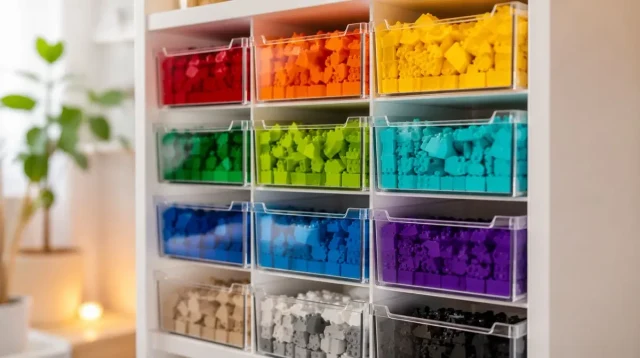
Sorting by color looks satisfying in photos but it's genuinely the worst system for a small space, because it means digging through a bin of grey pieces that includes everything from 1x1 plates to giant Technic beams. Sort by piece type and size instead: baseplates and large flat pieces in one shallow, wide container, small common pieces (1x1 and 1x2 studs, plates, tiles) in a compartmented case, and everything specialty (minifigure accessories, printed tiles, rare colors) in a small labeled box you actually remember exists.
The frequency part matters just as much in tight quarters. Keep the pieces you reach for constantly (basic bricks, plates, wheels) in the most accessible spot, even if that means the rarer stuff goes on a higher shelf or in the back of a closet. You'll thank yourself the next time you're mid build and need a 2x4 brick in a hurry rather than a specific gold lightsaber hilt you use twice a year.
Compartment cases beat drawer units for small footprints
Big multi-drawer parts organizers are great, but they're wide, and wide is exactly what you don't have in a small room. Stackable compartment cases, the kind with a hinged lid and adjustable dividers, take up a fraction of the footprint of a drawer unit and stack vertically instead of sprawling sideways. You can store several cases in the same width one drawer unit would need, and each case is small enough to pull out, sort through, and put back without rearranging the whole system.
The trade-off is that compartment cases hold less volume per case than a big drawer, so you'll need a few more of them for the same total capacity. That's a fair trade in a small space, where a handful of stackable cases tucked into a closet shelf beats one bulky unit that eats a whole corner of the room.
Label the outside of every case, not just the inside dividers. In a small space you're usually stacking cases three or four high, and the ones on the bottom are invisible until you label the short edge that still faces out when they're stacked. A strip of masking tape and a marker does the job as well as anything fancier, and it means you're not lifting three cases off the top just to find the wheels.
Rotate what's on display instead of displaying everything
This is the mindset shift that actually solves small space storage more than any bin or shelf does. You don't have to display every set you've ever built. Pick a shelf, a windowsill, or a small display cabinet and treat it as a rotating gallery rather than a permanent archive. When a new build is finished and the shelf is full, something else comes down, gets a light dusting, and goes into a labeled storage box instead of the landfill of a junk drawer.
This also solves the guilt problem that a lot of builders run into: the sense that taking a set apart or boxing it up means you didn't really value it. Treat disassembly as a normal part of the hobby in a small space, the same way you'd rotate seasonal decor, and it stops feeling like a loss. Photograph the finished build before it comes down if you want a record of it. That's often enough.
A rotation also gives you a natural rule for what to buy next. If nothing on the shelf is worth taking down, that's a decent sign the newest set isn't as exciting as you first thought, and it's fine to let it stay in the box a while longer. Small spaces have a way of turning impulse purchases into deliberate ones, mostly because there's nowhere to hide a set you didn't really want.
Minifigures need their own small system
Minifigures are deceptively space-hungry for how small they are, mostly because a loose pile of them takes up more usable volume than the same number packed into a proper case, and they're a nightmare to find one specific figure in once the pile grows. A shallow, compartmented minifigure case (the kind built for exactly this) solves both problems in very little footprint, and it displays reasonably well if you leave the lid open on a shelf.
If you'd rather display minifigures than box them, a slim wall-mounted rail or a narrow stepped stand takes up almost no floor or shelf depth compared to laying them out on a flat surface. Either way, resist the urge to just toss loose figures into the same bin as bricks. They get lost in there, and separating a hundred grey legs from a hundred grey plates later is not a fun afternoon.
Accessories are the part people forget. A minifigure without its hat, tool, or weapon reads as incomplete even if the figure itself is fine, so keep a small dedicated compartment just for accessories rather than letting them scatter into the general parts bins. It's a five-minute habit that saves a much longer hunt later.
Use the space furniture already gives you
A small room usually already has storage you're not using for LEGO: the space under a bed, the top shelf of a closet, the gap behind a door, the dead zone above a wardrobe. Shallow under-bed bins with wheels are a genuinely good fit for baseplates, large builds you want to keep intact, or instruction manuals you're saving for a rebuild later, and they disappear from view entirely when you're not using them.
Over-door organizers, the kind meant for shoes or accessories, work surprisingly well for compartment cases or small sorted containers too, since they use a strip of vertical space that would otherwise sit empty. None of this requires buying furniture built specifically for LEGO storage. Most of it is just noticing which corners of a small room are currently doing nothing.
Keep instructions and boxes separate from parts
Instruction booklets and boxes take up real space if you keep every one of them, and in a small room that space adds up fast. A practical middle ground: keep the physical booklet only for sets you might actually rebuild or resell, and rely on digital instructions for everything else, since most current sets have them available through official apps. Flatten and recycle the boxes once you've confirmed all the pieces and bags are accounted for, unless you're planning to resell the set later, in which case the original box matters for resale value.
This one small habit, letting go of boxes and instructions you don't need, tends to free up more shelf space than any bin or organizer you could buy. It's the cheapest storage upgrade in this whole guide.
Common questions
What's the best LEGO storage system for a small bedroom?
Stackable compartment cases on a narrow, tall shelf tend to work best in a small bedroom, since they use vertical space rather than floor space and keep sorted parts out of sight when you're not building. Pair that with a rotating display shelf for finished sets so you're not trying to keep every build out at once.
Should I sort LEGO pieces by color or by type?
By type, especially in a small space. Sorting by color looks tidy but makes finding a specific piece slower, since a bin of one color still mixes every shape and size together. Sorting by piece type and size (bricks, plates, specialty pieces) gets you to the part you need much faster, which matters more when storage space is limited.
How do I store finished LEGO sets if I don't have room to display them all?
Treat your display space as a rotation, not a permanent archive. Keep a handful of favorites out, photograph builds you love before taking them apart, and store the rest disassembled or boxed in labeled containers. Under-bed bins and closet shelves are usually enough for sets you're not actively displaying.
Do I need to keep the original LEGO boxes and instructions?
Only if you plan to resell the set later, since an intact box helps resale value, or if it's a set you expect to rebuild and want the paper instructions for. Otherwise, digital instructions through official apps cover most current sets, and recycling the box once you've confirmed all pieces are present frees up real shelf space.
Related articles
 Guide
GuideWhere to Watch LEGO Masters (US, Canada, UK, Australia)
A country-by-country guide to legally streaming LEGO Masters US and the Australian spinoff, plus the real story on the UK version and season 6.
 Guide
GuideIs the LEGO Rivendell Worth It? (Honest Take)
Rivendell is 6,181 pieces of elves, waterfalls, and Elrond's council chamber. Here's what actually makes it worth the shelf space, and who should just buy the poster instead.
 Guide
GuideLEGO Masters UK: The Original Show and What Happened to It
The UK version started it all in 2017, ran two series with no cash prize, then quietly stopped. Here's what happened.