

LEGO Technic vs Regular LEGO: Which Should You Buy?
Technic and the classic brick-built System line solve different problems. Here's how to tell which one actually matches what you or your builder wants out of a set.
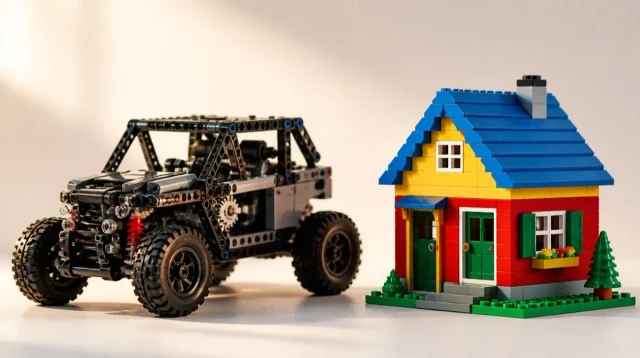
Every LEGO® aisle has the same split: a wall of familiar bright bricks on one side and a run of gray and orange boxes with gears and pins on the other. The question of LEGO Technic vs regular LEGO comes up constantly, and it's a fair one, because these aren't just two flavors of the same toy. Regular LEGO, the System line most people grew up with, is built from studded bricks that snap together and forgive almost any mistake. Technic swaps most of those bricks for beams, pins, and axles, and it's built around engineering, not decoration.
Neither one is the upgrade version of the other. A ten-year-old who loves building cars that actually steer wants something different from a builder who wants a detailed Star Wars ship to display on a shelf. This guide walks through what actually separates the two systems, who tends to enjoy each one, and how to think about a first purchase if you're standing in front of both sections trying to decide.
The short answer
Regular LEGO and Technic aren't competing for the same job. System bricks reward creativity, storytelling, and forgiving first attempts, while Technic rewards patience and mechanical curiosity with models that actually work. Pick based on what the builder likes doing, not which aisle looks more advanced, and don't be surprised if a serious builder eventually wants both.
What regular LEGO (System) actually is
The LEGO System line is the one most adults picture when they hear the word LEGO: studded bricks, plates, and specialty pieces that click onto a stud grid. It's the foundation for City, Creator, Friends, Star Wars, Icons, and most of the licensed sets you'll see in a store. The building logic is forgiving. Pieces connect vertically through studs, so even a shaky first attempt at following instructions usually results in something that looks like the picture on the box. That's a big part of why System sets work so well for younger builders and for anyone building for the first time in years. The pieces are colorful, the shapes are varied, and a lot of the fun is aesthetic: getting a minifigure's expression right, matching a color scheme, adding little details that don't do anything functionally but make a build feel finished.
What Technic actually is
Technic ditches most of the studded brick in favor of beams with holes running through them, connected by pins, axles, and gears instead of stud-to-stud clicking. Pieces attach at points along a beam rather than across a flat surface, which changes both how a model is built and what it can do once it's built. Technic sets are engineered around mechanical function: steering that actually turns wheels, a piston that actually moves, a winch that actually lifts. Some larger Technic sets add pneumatic pumps or small motors, and the flagship builds run on real mechanical linkages rather than a sticker or a molded shape standing in for movement. The trade-off is that Technic building is less forgiving. A beam in the wrong hole, or an axle one notch off, can throw off an entire mechanism further down the instructions, and there's rarely a colorful, obviously wrong piece to tip you off the way there is with System bricks. Technic also runs a much wider range internally than most people realize. There are small, entry-level sets built around one simple function, like a car with working suspension, and there are enormous flagship builds with multiple motors, a control app, and hundreds of moving parts. The name covers a spread almost as wide as System does, just aimed entirely at mechanics instead of scenes and characters.
Skill level and age: the real dividing line
LEGO's own age guidance on boxes gives you a rough starting point, but the more useful signal is what kind of building your kid (or you) actually enjoys. Younger builders and anyone new to LEGO generally do better starting in System, because mistakes are visible and easy to correct, and the reward is immediate: a recognizable house, car, or character. Technic asks for more patience and more spatial reasoning. You're often building a mechanism you can't fully appreciate until several steps later, when a hidden gear train finally engages and something on the outside starts moving. Kids who like taking things apart to see how they work, or who gravitate toward real vehicles and machinery, tend to be the ones who stick with Technic past the first frustrating session. If a first Technic set turns into a fight over confusing instructions, that's not a sign the kid can't build. It's often just a sign the entry point was too advanced, and a simpler System set or an early Technic set with fewer functions is the better next step.
Price and piece count: what you're really paying for
Comparing price per piece across the two lines can be misleading, because you're not buying the same thing. A System set's price reflects part variety, color, and often licensing costs for a themed property. A Technic set's price reflects precision engineering: the gears, pins, and axles are often more expensive to produce than a standard brick, and larger sets with motorized functions or pneumatic elements carry that cost. It's common for a Technic set to feel like it has fewer pieces for the price than a comparable System set, but the pieces themselves are doing more mechanical work. If you're budgeting for a gift, it helps to think in terms of what the builder will do with the finished model rather than pieces per dollar. A System set is often played with immediately, rearranged, and mixed into a broader collection. A Technic model, once finished, is usually displayed or operated as-is, since taking it apart to rebuild something else is a bigger undertaking than pulling apart a brick house.
Display versus play: how each one lives after the build
This is where a lot of buyers get surprised. System sets, especially in themes like Icons or Creator Expert, tend to be built once and displayed, but the pieces stay flexible; a kid can absolutely pull a City set apart afterward and build something else out of the bricks. Technic sets are usually built once and either displayed as a finished machine or actively played with as that machine, using its actual steering, winch, or suspension. They're much less likely to get broken down for parts, partly because the specialized beams and pins don't recombine into new creations as easily as universal studded bricks do, and partly because a working model with real mechanical function feels like it should stay built. If you know a set is going straight onto a shelf and never touched again, either system works. If you know the model is going to get handled, driven around, and shown off to anyone who visits, Technic's actual function tends to hold up better over time than a System model's static detailing.
Can you mix the two?
Yes, and a lot of builders end up doing exactly that once they've built in both systems for a while. Many Technic elements, especially pins, axles, and certain beams, are compatible with standard System studs, and a good number of Technic sets include a handful of regular bricks for detailing (a driver's seat, a grille, a decorative panel). Builders who get comfortable in both systems often start customizing: adding System detailing to a Technic chassis, or building a functional Technic element like a small crane arm into an otherwise System-based city scene. It's not something a first-time builder needs to worry about, but it's worth knowing the two aren't walled off from each other. If someone in your house eventually gets serious about building, having a mixed collection from both lines opens up a lot more creative range than sticking to just one.
How to actually decide
Start with what the builder already likes to do, not with which aisle looks more impressive. If they like assembling scenes, characters, and stories, System is the better entry point, and there's a System set for essentially every interest from space to farms to city life. If they like understanding how things work, taking toys apart, or building real vehicles and machinery, a smaller Technic set is worth trying, ideally one without a motor at first so the core mechanical building experience isn't complicated further by electronics. For adults returning to LEGO after years away, the same logic applies: pick based on whether you want a relaxing, forgiving build with a great-looking result, or a genuine engineering puzzle where the payoff is watching something you built actually move. And if you're still not sure, buying one smaller set from each line and seeing which one gets rebuilt or replayed with tells you more than any guide can. Kids especially show their preference fast once both options are actually sitting on the floor in front of them.
Common questions
Is Technic harder to build than regular LEGO?
Generally yes. Technic building relies on beam and pin connections that are less visually forgiving than stud-based bricks, and a small misalignment early on can affect a mechanism many steps later. Builders new to LEGO altogether typically have an easier first experience with System sets, then move into Technic once they're comfortable following more technical instructions.
Are Technic pieces compatible with regular LEGO bricks?
Many are. Technic pins, axles, and certain beams connect to standard studs, and a lot of Technic sets include some regular bricks for detailing. The two systems aren't fully interchangeable, since Technic's core connections are pin-and-beam rather than stud-based, but experienced builders do combine both in the same model.
Which is better for a beginner, System or Technic?
System (regular LEGO) is typically the better starting point. It's more forgiving of building mistakes and gives a recognizable result quickly, which builds confidence. A simpler, smaller Technic set without motorized functions can be a good next step once someone is comfortable following more involved instructions.
Do Technic sets need batteries or motors to be worth buying?
No. Plenty of well-regarded Technic sets are fully mechanical, using gears, pistons, and steering linkages that move by hand rather than by motor. Motorized and pneumatic functions show up mostly in larger, more expensive sets, but the core Technic building experience doesn't require them.
Related articles
 Guide
GuideWhere to Watch LEGO Masters (US, Canada, UK, Australia)
A country-by-country guide to legally streaming LEGO Masters US and the Australian spinoff, plus the real story on the UK version and season 6.
 Guide
GuideIs the LEGO Rivendell Worth It? (Honest Take)
Rivendell is 6,181 pieces of elves, waterfalls, and Elrond's council chamber. Here's what actually makes it worth the shelf space, and who should just buy the poster instead.
 Guide
GuideLEGO Masters UK: The Original Show and What Happened to It
The UK version started it all in 2017, ran two series with no cash prize, then quietly stopped. Here's what happened.