

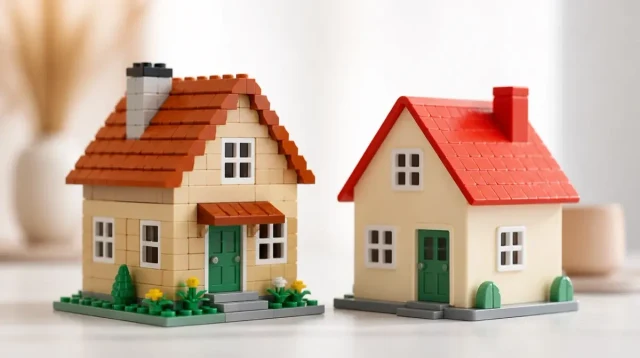
LEGO vs Playmobil for Kids
Two very different building toys get lumped together at gift-buying time. Here's what actually separates them, and which one fits the kid you're shopping for.
The lego vs playmobil question comes up every holiday season and every birthday in between, usually from a relative standing in a toy aisle trying to figure out which box to grab. It's a fair question, because the two brands look adjacent on a shelf but play almost nothing alike once they're out of the box. LEGO is a building system first and a toy second. Playmobil is a toy first, one that happens to come partly assembled and partly snapped together by a kid.
Neither is the objectively better toy. They reward different kinds of play, and a lot of families end up owning both without much overlap. What follows is a plain breakdown of where they actually differ (build process, play pattern, durability, cost per hour of use) so you can match the toy to the kid instead of the brand.
The short answer
LEGO and Playmobil solve different problems for different kids. LEGO rewards patience, sequencing, and rebuilding; Playmobil rewards fast setup and imaginative, figure-led scenes. Match the toy to how your specific kid already plays rather than treating this as a brand loyalty question, and you'll get a lot more use out of whichever box ends up under the tree.
The build experience is not the same kind of activity
A LEGO set gives you a bag of loose bricks and a picture of what they become. The building is the point for a good chunk of the time you own the set, especially with anything over a few hundred pieces. Kids follow numbered steps, find the right piece in a pile, and watch a shape emerge over an afternoon or two. That process teaches sequencing and patience, and it's genuinely satisfying for a kid who likes puzzles.
Playmobil sets snap together in minutes, sometimes less. A few clips, a figure or two clicked into place, and you're playing. There's no instruction-following marathon and no sorting through a pile of grey 1x2 plates looking for the one you need. For a younger kid, or one who gets frustrated fast, that's not a lesser experience, it's the right one. The build isn't the toy. The build is just getting to the toy.
What happens after the build is where the real gap shows up
Once a LEGO set is finished, play tends to be modular and additive. Kids swap pieces between sets, build their own variations, or take a set apart entirely to make something new with the pile. The system rewards owning more than one set, because a kid with three City sets can build a whole town that none of the individual boxes intended.
Playmobil leans into scene-based, figure-led play from the moment the box opens. The figures have more built-in articulation and expression than most LEGO minifigures, and the sets are designed around a specific setting (a farm, a hospital, a pirate ship) that a kid acts out rather than rebuilds. If your kid narrates stories with their toys and moves figures around a fixed set, Playmobil tends to hold their attention longer than a finished LEGO model, which mostly just sits there once it's built.
Durability and the toddler test
Playmobil generally wins on durability for younger hands. The figures and accessories are chunkier, harder to lose, and built to survive being dropped, sat on, and left in a sandbox. There's less risk of a tantrum over a snapped piece because there's less to snap. Fine LEGO pieces (antennas, thin clips, tiny printed tiles) are the parts that go missing under the couch and the parts a toddler can choke on, which is why LEGO's own age guidance steers the smallest pieces toward older builders.
That said, a finished LEGO build is sturdier once it's assembled than people expect, since the clutch power of the bricks holds a model together through a fair amount of rough play. The vulnerable window is really the loose-piece stage, both during building and if the model ever gets broken back down.
Piece compatibility and long-term collection building
LEGO's brick system has stayed compatible across decades, so a kid can mix a set from this year with hand-me-down bricks from an older sibling, a cousin, or a garage sale bin, and everything still clicks together. That compatibility is a real part of the value proposition. A pile of mixed LEGO becomes more useful the bigger it gets, since more pieces mean more possible builds.
Playmobil pieces are also broadly compatible across product lines and years, and figures move freely between different Playmobil sets and themes. The collection-building instinct works similarly for both brands: buy one set and it's a toy, buy several over time and it becomes a world the kid keeps expanding. Where they part ways is what "expanding the world" actually looks like, building new structures from a shared brick pool versus adding new figures and scenes to an existing setting.
Cost and what you're actually paying for
We won't quote specific prices here since they shift constantly and vary a lot by set size and license, but the general shape of the value is worth knowing. LEGO sets with a strong licensed theme (Star Wars, Marvel, Harry Potter) typically carry a premium over an unlicensed City or Creator set with a similar piece count, because part of the price is going to the license, not just the plastic. Playmobil doesn't lean on licensed franchises to nearly the same degree, so its pricing tends to track more directly with the physical amount of stuff (figures, accessories, vehicle parts) in the box.
The more useful comparison than sticker price is hours of engagement per dollar. A kid who rebuilds and remixes a LEGO set gets ongoing value out of the same pile of bricks for years. A kid who plays out long imaginative scenes gets that same ongoing value from a Playmobil set, just through a different mechanism. Buying the wrong one for your specific kid is the real way to waste money, not picking the wrong brand in the abstract.
Which one actually fits your kid
If your kid likes puzzles, follows instructions well, and gets a kick out of finishing something, lean LEGO. If they lose patience with multi-step building but light up when they're narrating a story with toys in hand, lean Playmobil. Age matters too. Playmobil's chunkier pieces and quick assembly make it a friendlier entry point for kids around four to seven, while LEGO's step-by-step sets tend to click better once a kid is reading well enough to follow instructions on their own, roughly seven and up, though plenty of younger kids build happily with an adult alongside them.
A lot of families end up with both brands living on the same shelf, and that's not indecision, it's two different toys doing two different jobs. If you're only buying one this year, go with the one that matches how your kid already plays, not the one that photographs better in a gift guide.
Common questions
Is LEGO or Playmobil better for a 4 year old?
Playmobil is usually the easier fit at four. The figures are chunkier, the assembly is quick, and a kid that age gets straight to imaginative play instead of working through a long instruction booklet. LEGO has some sets aimed at younger builders too (bigger bricks, simpler steps), but the bulk of the LEGO catalog assumes a kid who can sit through a longer build.
Can LEGO and Playmobil pieces be used together?
Not really, and not by design. The two systems use different connection mechanisms (LEGO's stud-and-tube clutch versus Playmobil's clip-based joints), so bricks and figures from one brand don't attach to the other. Kids will still put them in the same play scene together, a LEGO house next to a Playmobil farm, but the physical pieces themselves don't interlock.
Which brand has better resale value?
LEGO generally holds resale value better, especially retired licensed sets that are reported to climb in secondhand marketplaces after LEGO stops producing them. Playmobil sets can hold value too, particularly older or discontinued lines, but the secondhand market for LEGO is bigger and more active, which tends to mean more buyers and more predictable pricing if you ever want to resell.
Do Playmobil sets have instructions like LEGO does?
Yes, most Playmobil sets include a simple instruction sheet, but it's typically a fraction of the length of a comparable LEGO booklet. The steps are fewer and the pieces are larger, so building rarely takes more than 15 or 20 minutes even for a bigger set, versus the multi-hour builds common in larger LEGO sets.
Related articles
 Guide
GuideWhere to Watch LEGO Masters (US, Canada, UK, Australia)
A country-by-country guide to legally streaming LEGO Masters US and the Australian spinoff, plus the real story on the UK version and season 6.
 Guide
GuideIs the LEGO Rivendell Worth It? (Honest Take)
Rivendell is 6,181 pieces of elves, waterfalls, and Elrond's council chamber. Here's what actually makes it worth the shelf space, and who should just buy the poster instead.
 Guide
GuideLEGO Masters UK: The Original Show and What Happened to It
The UK version started it all in 2017, ran two series with no cash prize, then quietly stopped. Here's what happened.