

Which LEGO Sets Will Be Worth Money? (What Actually Appreciates)
Not every retired set turns into a return. Here's what actually separates the sets that hold or gain value from the ones that just sit in a closet.
We get some version of this question constantly: which LEGO sets will be worth money down the road? It's a fair thing to wonder, especially once you've seen a headline about some old Star Wars set selling for many times its original price. The honest answer is that most sets never appreciate meaningfully at all, and the ones that do share a small handful of traits you can actually spot before you buy, not after.
LEGO doesn't publish a retirement calendar or a resale forecast, so nobody, including us, can tell you a specific set will be worth a specific amount on a specific date. What we can do is walk through the patterns that show up again and again in sets that reportedly hold or grow in value on the secondary market, and just as importantly, the patterns in sets that don't. If you're buying purely to build and display, none of this matters much. If part of the appeal is that the set might be worth something someday, it helps to know what you're actually betting on.
This isn't a promise that any specific set will be worth money. It's a way to think about the odds.
The short answer
If appreciation matters to you, look for real sold-out demand (not just retirement), size and prestige within a theme, and box condition you can control from day one. Most sets never become an investment, and that's fine, they're still toys first.
Scarcity has to be real, not assumed
The single biggest driver of secondary market value is how many of a set ever existed relative to how many people want one once it's gone. A set that sold slowly for years and quietly disappeared usually isn't scarce in any way that matters, because plenty of unsold stock likely sat in stores and warehouses right up until the end. A set that sold out repeatedly, got restocked, and still sold out again is a different story. That kind of demand pattern suggests real scarcity once production actually stops.
The trap here is assuming any retired set is automatically scarce just because you can't buy it new anymore. Retirement isn't rarity. LEGO produces large exclusive sets in big enough numbers that plenty of them exist for years afterward, and it also produces smaller licensed sets that were never popular enough to sell through in the first place. Scarcity is about demand outlasting supply, not just supply drying up.
One rough proxy worth checking before you buy: was the set frequently out of stock while it was still active on shelves? A set that was chronically hard to find new is a much better candidate for real scarcity than one that sat quietly discounted for a couple of years before it disappeared. Neither pattern is a guarantee, but they point in very different directions.
Size and theme prestige matter more than piece count alone
Large, flagship sets in prestige themes have the best track record of holding value after retirement, and it's not a coincidence. Sets like the Millennium Falcon (75257) or Hogwarts Castle (71043) sit at the top of their theme, get built once and displayed for years rather than played with and broken down, and appeal to adult collectors who buy a second copy specifically to keep sealed. That second, sealed copy is what actually drives the secondary market, since a built set has essentially no resale value beyond parts.
Smaller sets in the same theme rarely see the same appreciation, even when the theme itself is popular. A licensed set under a few hundred pieces is usually treated as a toy, gets built, gets played with, and eventually gets broken down or lost piece by piece. There's rarely a healthy population of sealed copies left to create scarcity, because most buyers never intended to keep theirs sealed in the first place.
This is worth sitting with if you're shopping with resale in mind, because it means the price tag alone isn't the signal. A modest, mid-sized set in a beloved theme can still be a weak candidate, and an expensive flagship set can be a strong one, purely because of how each is treated by the people who buy it.
Licensed themes carry a different risk than LEGO's own designs
Star Wars, Harry Potter, and Marvel sets have a strong track record among collectors, largely because the underlying franchises have staying power that outlasts any individual LEGO release. A set like the Imperial Star Destroyer (75252) benefits from decades of Star Wars fandom on top of whatever LEGO-specific demand exists.
But licensed sets also carry a risk that in-house LEGO designs don't: the license itself can lapse, or LEGO can lose the rights to a property entirely, which typically ends any chance of a reissue and can affect how a theme is remembered. In-house themes like Modular Buildings, Ideas, and Creator Expert sets, think the Bookshop (10270) or NASA Apollo Saturn V (92176), don't carry that risk, since LEGO owns the design outright and can reissue or extend the line whenever it wants. That's part of why Modular Buildings in particular have such a strong long-term reputation with collectors.
Neither path is automatically the smarter one. A strong license can carry a set's reputation for decades even after LEGO moves on, and plenty of collectors are perfectly comfortable with that trade-off. The point is just to know which kind of set you're holding, so you're not surprised later by how its value behaves.
Condition is not optional, it's the whole game
A sealed box in good condition is worth meaningfully more than the same set built, and often worth more than the same set opened but never assembled. Box condition matters too. A creased, sun-faded, or water-damaged box can meaningfully drag down what a sealed set commands, even though the contents inside are untouched.
If you're buying with any intent to hold long term, that means treating the box itself as part of the product from day one. Store it flat, out of direct sunlight, somewhere the cardboard won't warp from humidity. It sounds fussy for what's ultimately a toy box, but the difference between a pristine sealed set and a beat-up sealed set is exactly the kind of thing that separates a real return from a disappointing one.
Opened but unbuilt sets sit in an awkward middle spot. Collectors generally still prefer a factory-sealed box, and an opened box, even with every piece accounted for, usually sells for noticeably less. If you've already opened a set you were hoping to hold onto, it's still worth keeping the pieces bagged and the instructions intact rather than assuming the damage is done.
Timing your purchase relative to retirement
The best window to buy a set with appreciation in mind is typically once it's confirmed retired, or clearly heading that way, but before the remaining retail stock has dried up and the secondary market has already adjusted upward. Buying the moment a set launches doesn't give you any edge. Buying years after retirement, once a set has already developed a reputation and a price history, means you're paying whatever premium has already built in.
The messy middle, where a set is rumored to be on its way out but LEGO hasn't said anything official, is where patience actually pays off. LEGO doesn't announce retirements ahead of time, so most of what circulates is inference from restocking patterns, retailer clearance activity, and how long a set has been on shelves. It's worth reading our piece on how retirement actually works before you try to time anything around it.
A useful habit is checking whether a set has started disappearing from major retailers one by one while still showing up elsewhere. That staggered disappearance is often a better signal than any single store going out of stock, since one retailer running low can just mean a slow restock, not an actual end of production.
What doesn't hold up, even when people expect it to
Small licensed sets, promotional freebies, and anything produced as an obvious mass-market exclusive tend to disappoint collectors who bought expecting a return. The volume produced is usually high enough that scarcity never really develops, no matter how long the set has been off shelves.
Built sets are the other big letdown. Once a set is assembled, its resale value drops sharply, and it's essentially competing with used parts lots rather than with sealed retired sets. If appreciation is even part of why you're buying, the set has to stay in the box. That single decision matters more than almost anything else on this list.
Same goes for sets bought purely because a headline mentioned some other set's dramatic resale price. That kind of story almost always describes an outlier, a large flagship set that happened to hit every favorable condition on this list at once, not a typical outcome you should expect to repeat with an unrelated set just because it's also retired.
Common questions
Do all retired LEGO sets go up in value?
No, and this is probably the biggest misconception out there. Most retired sets are worth roughly what they cost new, or less, once you account for years of storage and inflation. Only a minority of sets, typically large flagship builds in popular themes that sold out repeatedly, develop real appreciation. Retirement alone doesn't create value; demand outlasting supply does.
Does a sealed set really matter that much versus a built one?
Yes, substantially. A sealed, undamaged box is what collectors are actually paying for, since it's the only version of the set that's provably complete and unhandled. Once a set is built, it's competing with the used market, not the sealed collector market, and the price gap between the two is usually large.
Is it better to buy at launch or wait until closer to retirement?
Neither extreme is obviously best. Buying at launch means paying retail before you know how the set will be received, while waiting until well after retirement often means paying a premium that's already built into the price. Many collectors aim for the window after a set is confirmed or strongly rumored to be retiring, but before stock has fully dried up.
Are Modular Buildings a safer bet than licensed sets?
They're a different kind of bet, not necessarily a safer one. Modular Buildings like the Bookshop don't carry license-expiration risk since LEGO owns the design outright, and the line has a strong long-term reputation with collectors. Licensed sets can benefit from a franchise's cultural staying power, but they also depend on LEGO keeping that license, which isn't guaranteed forever.
Related articles
 Guide
GuideWhere to Watch LEGO Masters (US, Canada, UK, Australia)
A country-by-country guide to legally streaming LEGO Masters US and the Australian spinoff, plus the real story on the UK version and season 6.
 Guide
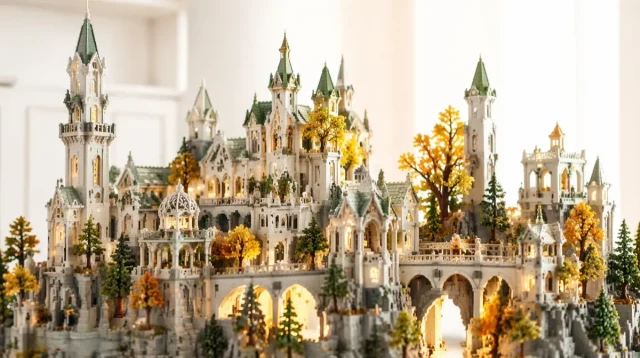
GuideIs the LEGO Rivendell Worth It? (Honest Take)
Rivendell is 6,181 pieces of elves, waterfalls, and Elrond's council chamber. Here's what actually makes it worth the shelf space, and who should just buy the poster instead.
 Guide
GuideLEGO Masters UK: The Original Show and What Happened to It
The UK version started it all in 2017, ran two series with no cash prize, then quietly stopped. Here's what happened.