Great Pyramid of Giza
A cutaway pyramid that hides its cleverest trick right inside the sand.
As an Amazon Associate we earn from qualifying purchases.
Verdict
This one won me over slowly, because at first glance it looks like a beige triangle and I was ready to shrug.
Then you realize it's a cross-section, the shell lifts off, and there's a whole under-construction ramp system buried inside. It's more of a history diorama than a strict Architecture model, and I mean that as a compliment. If you love the ancient world you'll adore it, and if you only came for the shape of the pyramid you might feel a bit short-changed by the price.
Best forHistory buffs who want a display piece with a story hidden inside it
The build and parts
What it is
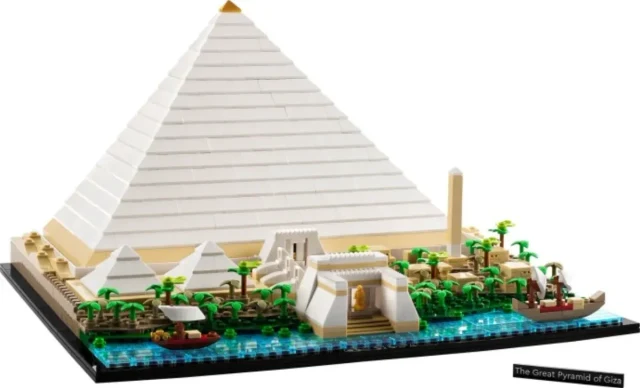
Some LEGO® sets sell themselves in the box art, and this one really doesn't. It's a tan pyramid, and I'll be honest, my first reaction was a polite nod and nothing more. Then I understood the trick. This is a cross-section, not a solid model, and the whole point is what's hidden inside. Lift the outer shell away and you find the main tunnels, the King's and Queen's chambers, and a proposed system of internal ramps that ancient builders may have used to haul those enormous stones up the middle. It reframes the whole set. Suddenly you're not building a shape, you're building a theory about how one of the Seven Wonders actually went up, and that shift from architecture to storytelling is what makes it special.
The catch
Now for the honest part of the ledger, because there's a real one. You get half a pyramid. LEGO cut the model down the middle so you can see inside, which is smart, but it does mean the finished thing has a flat back and looks incomplete from certain angles. The set even includes axle holders on the base so you can join two copies together, and plenty of builders tried. The catch is that two sets don't line up the way you'd hope. The interior corridors don't match, you end up with two front entrances, and the Nile ends up flowing down both sides, which no river has ever done. So the dream of a big magical full pyramid needs a custom rebuild and a google search, not just a second box. On top of that, the price sits around 129 dollars for 1,476 pieces, and a lot of those are small tan slopes and tiles, so the value math is not the strongest in the Architecture lineup.
Who it's for
Here's where I land. If you're drawn to ancient Egypt, to history, to the idea of a model that teaches you something while it sits on your shelf, this set is genuinely lovely and I think you'll keep noticing new details for weeks. The under-construction half, the tiny sphinxes, the little boats, the layered dunes, it all adds up to a scene rather than a single object, and scenes are more fun to live with. If you mainly wanted a crisp, complete pyramid to admire from every side, or you count value in cents per piece, this probably isn't the one for you and you won't be wrong to skip it. It's retiring now in July 2026 too, so if it's been sitting on your maybe list, the decision window is closing. For the right person it's a keeper, just go in knowing it's a cutaway, not a solid wonder.
The parts story
What the build is actually like, and the pieces worth knowing about.
The build is more relaxing than challenging, and that suits it. You start with the landscape base, laying out the Nile and the layered banks of sand, then you build the two removable inner pyramids, the finished new-condition one and the under-construction version with its exposed ramp. After that comes the outer shell that drops over the top. The repetition is real, since you're placing a lot of tan slopes in sequence, but the pacing is broken up nicely by the little side builds. The feluccas, the sphinxes, the small pyramids, temples and obelisk all give you quick satisfying breaks between the bigger tan sections, so it never feels like pure grind.
This isn't a set chasing rare molds, it's a set built on smart use of ordinary parts. The star technique is the dune work, where inverted 1x3 slopes get paired with regular 1x3 slopes to fake soft rolling sand at microscale, and it looks far better than a stack of plates would. You're working almost entirely in tan and dark tan, with white for the sphinxes and clever little SNOT sections for the interior chambers. Nothing here is a printed showpiece or a brand new element you'll brag about, so parts collectors won't be raiding it. What you're really paying for is the design idea and the huge footprint, since at 40 by 42 studs this is one of the largest Architecture models by area, not a bin of exotic bricks.
Fun facts
- 01The model is a cross-section that only shows half the pyramid, which let the designers reveal the internal ramp theory of how the ancient stones may have been hauled up the middle.
- 02It includes two separate inner pyramids, one finished and one still under construction, so you can display the same wonder in two eras at once.
- 03At roughly 40 by 42 studs at the base, it is one of the largest LEGO Architecture models ever made by surface area.
- 04The Great Pyramid is the only one of the Seven Wonders of the Ancient World still standing, which makes the historical detailing here feel especially fitting.
Sources
Further reading and sources for this review.