NASA Apollo Lunar Roving Vehicle - LRV
The moon buggy that folded up for launch, rebuilt in 1,913 Technic pieces.
As an Amazon Associate we earn from qualifying purchases.
Verdict
The fact that humans parked a car on the moon and left it there still amazes me, and this LEGO set leans right into that story.
The folding deployment trick and how closely it mirrors the real Boeing rover make it stand out from the usual Technic supercar crowd. I do have to be honest that it feels delicate and a little flimsy in the hand, and the astronaut figure you'll want beside it is sold separately. Go in knowing that and it's a lovely piece of space history.
Best forAdult space nerds who want a display model with a working folding gimmick
The build and parts
What it is
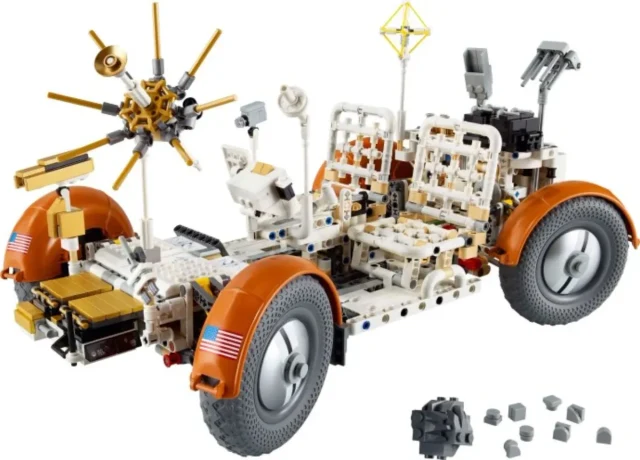
This is a LEGO set that isn't chasing horsepower or gullwing doors for once, and I found that refreshing. It's the actual moon buggy, the Lunar Roving Vehicle that Boeing built with GM and Goodyear and that astronauts drove across the surface on Apollo 15, 16 and 17. LEGO went with LRV-3, the one Gene Cernan and Harrison Schmitt used on Apollo 17, recreated at roughly 1:8 scale in 1,913 pieces. The headline feature is the deployment. The real rover launched folded flat against the lunar module, then unpacked itself onto the surface using ropes and pulleys, and this set lets you fold the wheels in and up and swing it back out, which is a genuinely uncommon trick for a Technic model. You also get switchable steering: connect the front, the rear, or both for four-wheel steering, and watch the turning circle tighten right up.
The catch
Now the part I have to be honest about, because reviewers across the board flagged the same thing. It's fragile. Even fully assembled the model flexes when you lift it, and the clips meant to lock the wheels in place have a habit of sliding loose, which means a wheel can tuck under the body and send the whole rover pitching over sideways. There's also a sense that it's doing too much at once, so no single feature really shines, and the instruction manual is stingy with actual facts about the mission. At around $220 retail it isn't cheap either, and the part-per-dollar math is fair rather than generous.
Who it's for
For space buffs, Apollo obsessives, and Technic fans who want something on the shelf that tells a story instead of another race car, this is a real treat. It's a display model first and a fiddle-with-it toy second, so if you want rock-solid engineering you can toss around, look elsewhere. But if you'll set it on a shelf, occasionally fold it up to show a friend how NASA packed a car for a rocket, and add the separately sold Creator astronaut beside it, you'll be really happy. One heads-up: it's scheduled to leave shelves around the end of 2026, so I wouldn't sit on it forever if you want one.
The parts story
What the build is actually like, and the pieces worth knowing about.
The build comes in four main modules and it paces itself nicely. You start with the four-wheel chassis that carries the seats and the control and display console, then move to the front section with its high-gain dish antenna and TV camera, then the Lunar Communications Relay Unit with a low-gain antenna and 16mm camera, and finally the rear tray packed with tools and lunar experiments. LEGO does a smart thing here: nearly every bag ends by introducing a new feature, so the rover visibly grows and you're never just grinding through repetitive framework. It's a mid-length Technic build that rewards patience more than it tests it.
The parts are where this set really earns its keep for collectors, and this is the bit that won me over. The wheels are unlike anything LEGO had made before, so brand new tyre molds (and likely new wheel molds) were tooled just for this rover to capture that open wire-mesh look. On top of that you get set-specific printing: American flags on the fenders, and silver 6x6 dishes standing in as printed hubcaps with white and black lines so you can actually see the wheels rotating. Add the printed console details and the pile of little tool and experiment builds on the rear tray, and there's a real haul of unusual, hard-to-find-elsewhere elements here. At 1,913 pieces for around $220 the raw value is middling, but a lot of that price is buying parts you simply can't get in other sets.
Fun facts
- 01The real rover let Apollo 17 astronauts Gene Cernan and Harrison Schmitt travel about 4.7 miles (7.6 km) from the lunar module, far beyond walking range.
- 02The actual LRV was a battery-electric vehicle with a separate motor on each of its four wheels, making it a four-wheel-drive EV decades before that was a marketing buzzword.
- 03Boeing built the rovers in partnership with General Motors and Goodyear, and all three are still parked on the moon where the crews left them.
- 04The set is scaled to match the astronaut minifigure from the Creator 31152 Space Astronaut set, which you have to buy separately to complete the display.
Sources
Further reading and sources for this review.