LEGO NASA Apollo Saturn V (92176)
A metre of moon-mission history that teaches you to build round.
Brick Rated Score
Set 92176 · 2020
Affiliate link. We may earn a commission at no extra cost to you.As an Amazon Associate we earn from qualifying purchases.
If space does anything for you, this is one of the easiest recommendations I can make, and it's one of the best-loved Ideas sets ever.
It's a metre-tall replica of the rocket that carried people to the Moon, and it looks brilliant standing up or laid flat on its stands. I'll be honest that it's retired now, so you'll pay a premium over the old RRP, and some of the build is genuinely repetitive. Perfect for a display fan or an Apollo obsessive, less so if you want tons of variety in the box.
Best for: space obsessives who want a proper display centrepiece
What it is
This is one of the most quietly beloved sets LEGO has ever put out, and I completely understand why. The NASA Apollo Saturn V is a metre-tall, roughly 1:110 scale replica of the rocket that carried humans to the Moon, and it started as a fan project on LEGO Ideas from Felix Stiessen and Valerie Roche before the crowd voted it into production. It first arrived as 21309 in 2017, sold out, and came back in 2020 as this near-identical 92176 because people kept asking for it. The whole thing splits into the three real Saturn V stages, complete with a tiny lunar lander, a lunar orbiter, and three little astronaut microfigures for playing out the mission. Stand it up and it towers over pretty much everything else on your shelf. Lay it flat on the three included stands and it becomes a long, satisfying museum-piece display. For anyone with even a passing love of the space race, it just lands.
The catch
Now the honest bit. A rocket is, when you get down to it, a stack of tubes, so a decent chunk of the build is repetitive. You'll do the same round-wall technique over and over up the body, and if you build in one sitting your brain might glaze a little around the second stage. There are a couple of design quirks too. The launch escape tower is stuck on the same long axle that holds the command module, so you can't just lift the tower off to swap configurations without popping bits loose, and the nose tip knocks off pretty easily. The two small lunar models are so simple they feel a bit tacked on, and they're small enough to vanish down the back of the sofa. The bigger catch in 2026 is price. It's retired, LEGO doesn't reissue Ideas sets, and a sealed box now goes for well over double the old $119.99. So you're buying a collectible, not a bargain.
Who it's for
If you're a space obsessive, an Apollo history buff, or someone who wants a single dramatic display piece with a real story behind it, this is a lovely set and worth hunting down even at aftermarket prices. It's also great for building alongside an older kid who's into rockets. If you crave variety, loads of fiddly detailing, or you get bored by repetition, the cylinder-stacking might wear on you, and if you just want the model cheap, that ship has sailed. But as a thing to build once and admire forever, it earns its 4.5 out of 5 reputation.
The parts story
What the build is actually like, and the pieces worth knowing about.
The build runs bottom to top through the three real rocket stages, which makes for a genuinely satisfying rhythm even when the middle sags a little. Each stage is a strong central core wrapped in curved outer walls, and this is where the set earns its keep as a teacher. You'll pick up a whole repertoire of round-building tricks, using hinges, brackets and clever wall segments to fake a smooth cylinder while keeping the internal structure rock solid. The stages connect with sturdy pins so the finished tower doesn't feel floppy despite the height. Build time lands around 4-6 hours depending on your pace, and there's a real payoff moment when you cap it with the command module and escape tower and stand the whole metre of it up for the first time.
Piece-wise, the headline is the trio of astronaut microfigures that debuted with the original 2017 release, a genuinely charming first for the theme. The rest of the parts list leans on masses of white curved slopes, cones and round bricks in the big cylinder sections, plus grey and black detailing for the engine bells at the base, which are some of the most fun parts to assemble. There aren't a load of flashy rare printed pieces here, the appeal is more about clever use of common parts at scale. On value, 1,969 pieces for the old $119.99 RRP worked out around six cents a part, which was excellent, and the piece count itself is a deliberate wink at the 1969 Moon landing.
Fun facts
- 01The 1,969 piece count is a deliberate nod to 1969, the year Apollo 11 put the first bootprints on the Moon.
- 02It began as a fan submission on LEGO Ideas by Felix Stiessen and Valerie Roche and took just over a year to hit the 10,000 supporters needed for LEGO to consider it.
- 03At a metre tall it became the tallest LEGO Ideas set ever at launch, built to roughly 1:110 scale of the real 111-metre rocket.
- 04This 92176 is a re-release of the 2017 original (21309), brought back in 2020 because demand stayed so high after the first version sold out and retired.
What other builders say
This write-up is grounded in real reviews and builder discussion, not just one opinion. A few worth reading:
More reviews
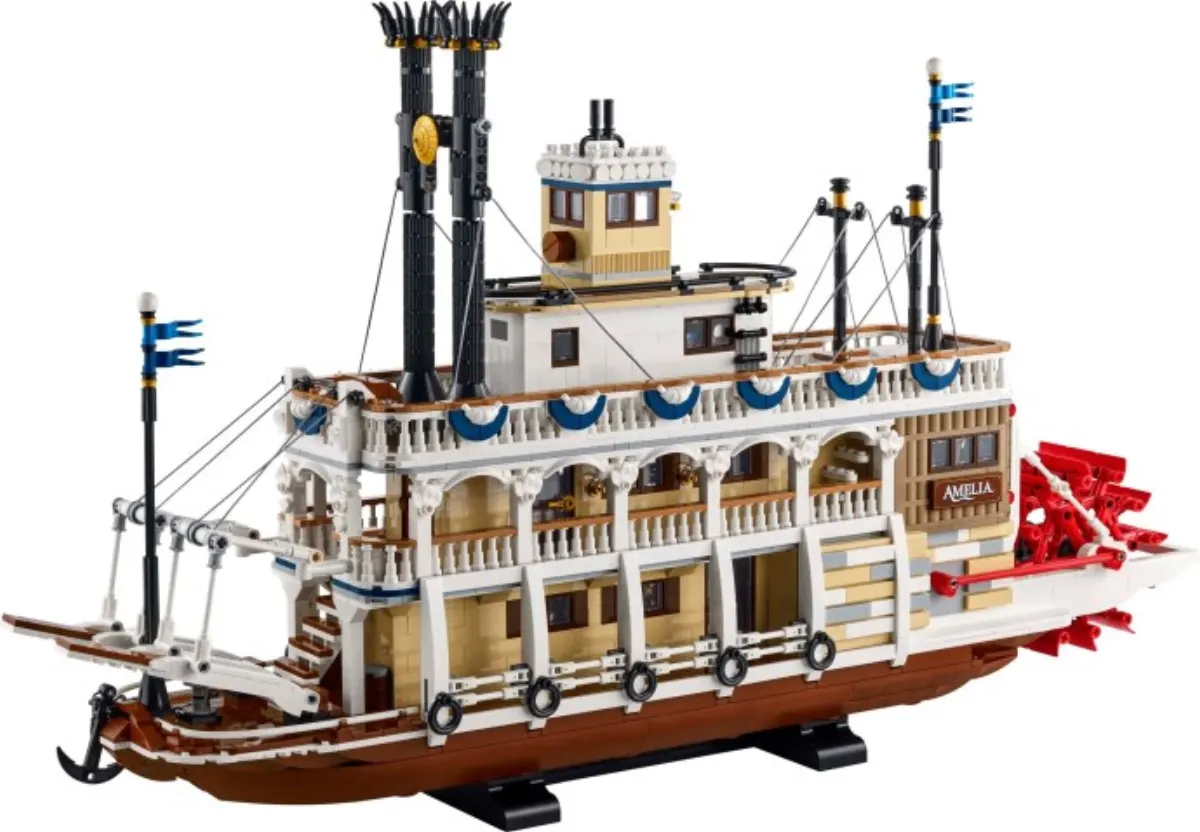
River Steamboat
The biggest LEGO Ideas set ever, and a proper working Mississippi paddle wheeler.

Home Alone
The McCallister house, booby traps and all, built brick by nostalgic brick.

The Botanical Garden
A Victorian glasshouse with 35 brick-built plants and a bag of clever parts tricks.