NASA Artemis Space Launch System Rocket
A little crank turns this rocket into a two-stage separation you can actually watch happen.
As an Amazon Associate we earn from qualifying purchases.
Verdict
I did not expect a 632-piece Technic set to make me grin the way this one did.
You turn a single crank and the whole SLS comes apart in sequence, boosters first, then the core stage, then the upper stage with Orion popping free, and it is genuinely satisfying every single time. At $59.99 it is one of the better value Technic sets of the year, and the only thing holding me back from raving is the sticker situation. If you love space and love watching a mechanism do its job, this is an easy yes.
Best forspace-obsessed builders (kids or adults) who want a working mechanism, not just a static rocket
The build and parts
What it is
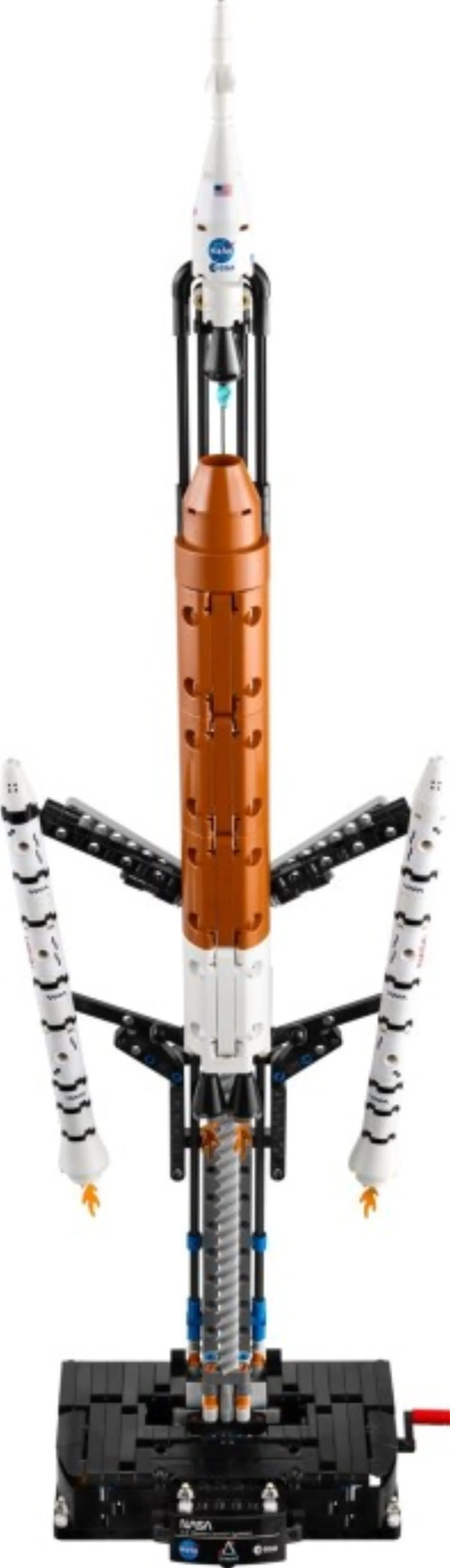
This is the Technic take on NASA's Artemis Space Launch System, the rocket meant to carry the Orion spacecraft back toward the Moon, and it is built around one very good idea. Instead of a static display rocket, the designer wired the whole thing to a single crank. You turn it and the two solid rocket boosters fall away from the core stage, keep turning and the core stage detaches, keep going and the upper stage lifts off with the engine module, Orion capsule and launch abort system separating on cue. The rocket grows almost 25cm taller as it deploys. The first time I ran it through the full sequence I immediately reset it and did it again, which is the highest compliment I can pay any function set.
The catch
I will be straight with you about the flaws, because they are real. The stickers are the big one. Roughly ninety percent of them sit on tightly curved surfaces, and multiple reviewers found them lifting at the edges within a few hours of building. For a company with LEGO's usually airtight quality control, that stings on a set this display-focused. There is also a fair argument that the mechanism is over-engineered, doing a lot of internal gymnastics for a fairly simple separation, and one reviewer received a copy with a misaligned worm gear that made the crank feel gritty. That last one reads like a single bad mold rather than a design fault, but it is worth knowing.
Who it's for
Here is who I would hand this to. Anyone with a genuine love of spaceflight, especially a kid nine or up who wants a model that does something rather than just sits pretty, will get an enormous amount out of it. It is also a smart pick if you want a big, impressive shelf piece without spending big, since it costs less than a quarter of the $260 LEGO Icons Artemis and still reads as a proper rocket from across the room. Who should skip it? If you are a purist who cannot stand stickers, or someone who wants intricate mechanical complexity to pore over rather than a single satisfying function, this may feel a touch thin. For everyone else, it is a lovely, playable, honestly priced set.
The parts story
What the build is actually like, and the pieces worth knowing about.
Building this one moves quickly and stays interesting, which is not always true of smaller Technic sets. Because everything feeds into that central separation mechanism, you are constantly seeing how the gears, axles and the crank tie together rather than just repeating panels. The designer added a small door in the base so you can watch the mechanism work rather than hiding it away, and that choice tells you the priority here was function you can see and understand. It is a build that teaches as it goes.
The standout part is the 6-long worm gear that builders affectionately call the 'fusilli gear' for its twisted shape. It has existed for a couple of years but had never appeared in a Technic set until this one, so it is a genuinely fresh functional element rather than a decorative recolor. The set also packs four little astronaut nanofigures and some bright blue flame pieces for the exhaust, plus a printed information panel to round out the display. At roughly 9.5 cents per piece the value is solid, and the fact that the newest part is a working gear rather than a sticker-bearing shell is exactly the kind of thing Technic fans want to see.
Fun facts
- 01The set was developed in collaboration with NASA and ESA, and it depicts the real rocket intended to send the Orion spacecraft into lunar orbit.
- 02It costs less than a quarter of the price of the $260 LEGO Icons version of the Artemis rocket, yet reviewers say it reads as just as convincing on a shelf.
- 03The 6-long 'fusilli' worm gear at the heart of the mechanism had existed for a couple of years but made its very first Technic-set appearance here.
- 04A LEGO Education classroom edition of this same rocket exists alongside the retail version, aimed at teaching launch stages in the classroom.
Sources
Further reading and sources for this review.