Baby Dinosaur Dolores: Aquilops
A tiny, obscure dinosaur gets the buildable-creature treatment, and it works.
As an Amazon Associate we earn from qualifying purchases.
Verdict
I love that LEGO picked Aquilops for this one instead of another Trex or raptor.
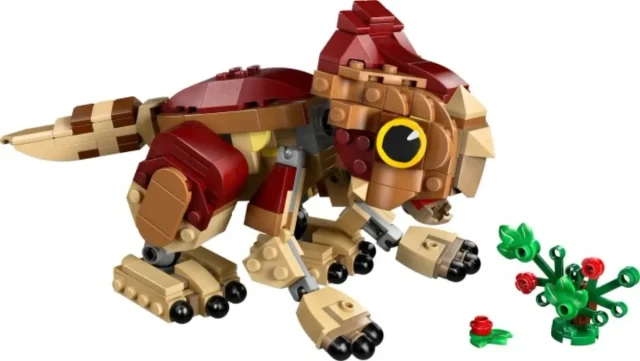
It is a real, honestly kind of adorable early Cretaceous herbivore about the size of a rabbit, and the model leans into that with a stubby parrot beak and a posable little body that can sit, walk, and tilt its head like it is actually curious about something. This is not a display shelf statue, it is a toy built to be picked up and played with, which I think is exactly the point of the Baby Dinosaur line. It is best for a younger builder or a Jurassic World completist who wants something different from the usual predator lineup, and less exciting for anyone chasing minifigs or vehicle play.
Best forYounger Jurassic World fans and dinosaur nerds who want a species other than the usual predators
The build and parts
What it is
I will admit my first reaction was curiosity more than excitement, because Aquilops is not a dinosaur most people have heard of. It is a small parrot-beaked ceratopsian, roughly rabbit sized, that lived in what is now Montana around 108 million years ago. LEGO built it with a stout little body, a short tail, and that unmistakable hooked beak, and gave the whole thing joints at the jaw, legs, and neck so a kid can actually make it graze, look up, or take a few steps across the carpet. That posability is what sold me on it. It does not just sit there looking like a model, it acts like a small animal.
The catch
I do want to be straight about the tradeoffs. This is a 339 piece set with no vehicle, no dig site, no supporting scene, just the creature itself, so once you have posed it a handful of ways there is not a lot of additional play loop built in. It also does not come stacked with minifigs the way a lot of Jurassic World sets do, so if you are building out the human side of the story this one will not scratch that itch. And because Aquilops itself is small and unfamiliar, it does not have the instant shelf presence of a Trex or Spinosaurus build.
Who it's for
Where I would point people is younger builders, roughly the age range these Baby Dinosaur sets are aimed at, who want something they can actually play with rather than just look at, and Jurassic World collectors who like the idea of owning a species outside the predator hall of fame. If you or your kid want a big showpiece dinosaur or a vehicle to go with it, this is not that set, but as a compact, posable, genuinely different little creature, it earns its spot.
The parts story
What the build is actually like, and the pieces worth knowing about.
The build itself moves fast, which fits a set aimed at younger hands. You start with a small ball and socket core for the body, then work outward to the legs and tail, and the head goes on last so you can test the jaw hinge as soon as it clicks into place. It is a satisfying build precisely because it is short, you get to the posable, playable result quickly instead of grinding through hundreds of structural pieces before anything moves.
The standout here is less about a single rare piece and more about how the joint system is used at a small scale. Ball joints at the hips and shoulders, a hinge at the jaw, and a rotation point at the neck give a 339 piece model a surprising range of poses for its size, which is the same technique LEGO has refined across its bigger buildable dinosaurs just scaled down. The color palette leans into warm tans and browns with a mottled, natural look rather than anything glossy or toy-bright, which helps sell Aquilops as a real animal instead of a cartoon dinosaur.
Fun facts
- 01Aquilops is a real dinosaur first named and described in 2014, based on a skull found in Montana, making it one of the more recently identified species LEGO has chosen for this line.
- 02It was a small early ceratopsian, roughly the size of a modern rabbit, and is considered one of the earliest known relatives of later horned giants like Triceratops.
- 03The name Aquilops comes from Latin and Greek roots referring to its eagle-like hooked beak, which the LEGO model reproduces as its most distinctive feature.
- 04Choosing a herbivore this small and obscure is unusual for the Jurassic World LEGO range, which has leaned heavily on marquee predators since the theme launched.