NASA Apollo 11 Lunar Lander
The Eagle in gold-flecked plastic, and honestly one of the most display-worthy sets under a hundred dollars.
As an Amazon Associate we earn from qualifying purchases.
Verdict
This one won me over the moment the ascent stage came off the base and I realized I was basically re-enacting 1969 on my desk.
It's a proper adult display set that costs less than you'd guess, with those metallic gold panels doing a lot of the heavy lifting. The two astronaut minifigs are the weak link and the octagonal base gets a bit samey, but the finished Eagle is gorgeous. If you love space history, you'll adore it.
Best forSpace-history nerds who want a striking display piece that won't break three figures
The build and parts
What it is
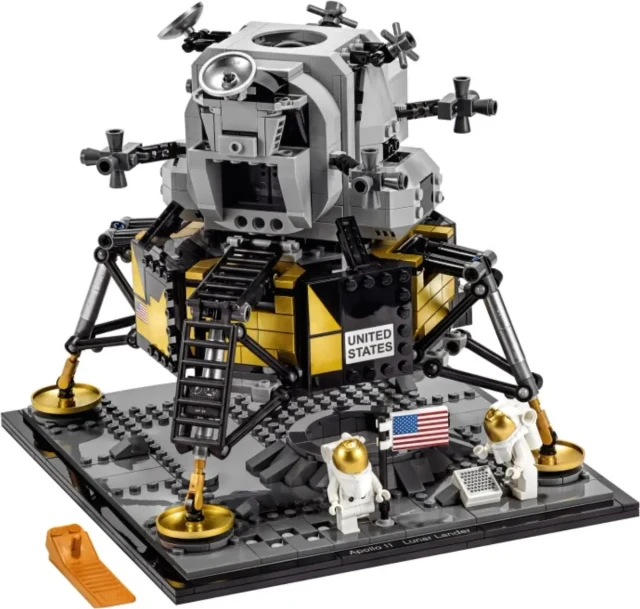
There's a version of this set that could have been a boring gray box, and instead LEGO made the Eagle look like it actually flew. The NASA Apollo 11 Lunar Lander (LEGO® set 10266) landed in June 2019 for the 50th anniversary of the moon landing, built with NASA, and it's the display companion to the enormous Saturn V rocket that came before it. What you get is a 1,087-piece replica of the Eagle lunar module sitting on a little slice of the moon, crater and footprints and tiny US flag included. It's not a huge set. It stands about 20cm tall and takes up roughly the footprint of a dinner plate. But it punches so far above its size that people who see it on a shelf tend to stop and ask about it, which is exactly what you want from a display piece.
The catch
The thing that sells it is the color. The descent stage is wrapped in new-for-2019 metallic gold panels and landing pads that recreate the gold foil insulation on the real lander, and that gold against the black and dark gray reads as genuinely convincing rather than gimmicky. The ascent stage lifts right off the base, which sounds like a small thing until you actually do it and feel a bit like Neil Armstrong. There's a detailed interior with room for both astronauts, plus a brick-built video camera and laser reflector as accessories, little nods to the actual mission gear left on the surface. The instruction manual is lovely too, opening with JFK's we-choose-to-go-to-the-moon speech and a chunk of Apollo history, so the whole experience feels considered from the first page.
Who it's for
Now the parts I'd want you to know before you buy. The octagonal descent stage is clever in how it holds those angles together, but building all eight identical sides in a row does get repetitive, and a few reviewers flagged that middle stretch as a slog. The bigger gripe is the minifigs. You get two astronauts with NASA torso printing and gold visors, and they're fine, but they're plainly the afterthought here and those golden helmets genuinely split opinion. And since the set retired at the end of 2023, you're now buying secondhand or from a reseller, usually a little north of the 99 dollar launch price. None of that is a dealbreaker for the right person. If you love space, if Apollo means something to you, if you want a shelf piece that looks like real hardware and didn't cost a fortune, grab it. If you're chasing wild engineering or you buy sets mainly for the minifigs, this probably isn't the one that'll get you, and that's completely fair. For me it sits comfortably near the top of the sub-hundred-dollar display sets LEGO has ever made.
The parts story
What the build is actually like, and the pieces worth knowing about.
The build works from the base up, so you start with the lunar surface and its crater and footprints, then construct the octagonal descent stage, and finish with the ascent stage that lifts off the top. That descent stage is where the interesting geometry lives, with panels angled around eight sides to nail the squat shape of the real lander, and it uses some genuinely satisfying sideways-building to lock those angles in. The catch is that once you understand the technique on side one, you repeat it seven more times, and that's the stretch where the pacing dips. The ascent stage picks the energy back up with a detailed interior and the fiddly antenna and thruster details up top. It's a relaxed, few-hours build rather than a marathon.
The stars of the parts list are those metallic gold elements, new for June 2019, including gold landing pads, gold panels, and a gold ladder, all of which turn up here for the first time and are worth a small fortune to anyone building their own space models. There are printed pieces too, most notably the Apollo 11 nameplate, plus the NASA-decorated astronaut torsos and the gold-visored helmets. At 1,087 pieces for an original 99 dollars, the per-part value is strong for a licensed display set, and the sheer volume of usable black, dark gray, and gold in one box makes it a quietly great parts pack on top of being a finished model.
Fun facts
- 01The set was developed in direct cooperation with NASA and launched in June 2019 to mark the 50th anniversary of the Apollo 11 moon landing.
- 02Those metallic gold landing pads, panels, and ladder debuted with this set, recreating the gold foil insulation that wrapped the real Eagle lander.
- 03The instruction booklet opens with President Kennedy's we-choose-to-go-to-the-moon speech and a run of Apollo mission history before the first build step.
- 04It retired in December 2023 after a roughly four-and-a-half-year run and has held its value well on the aftermarket.